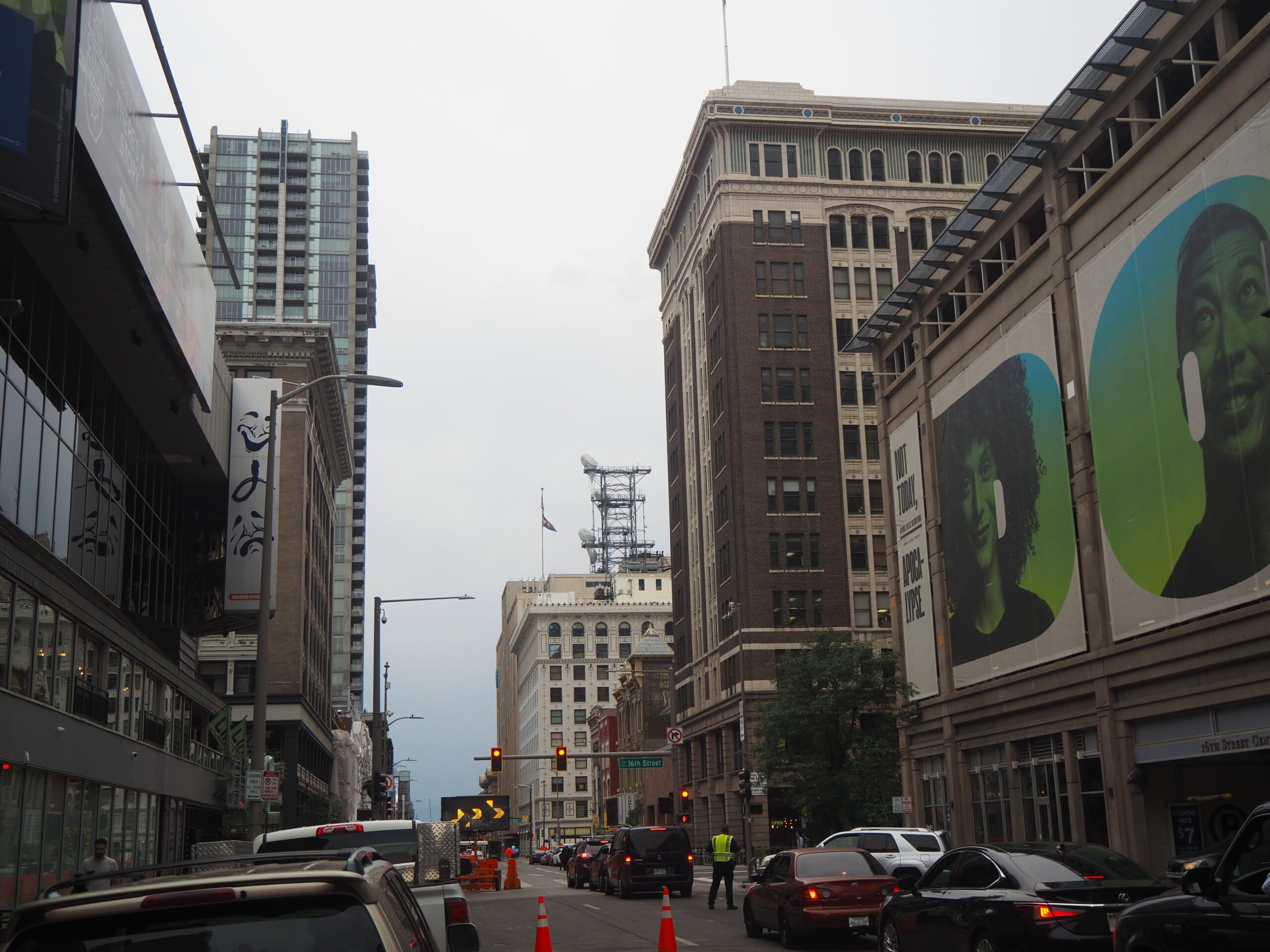
The intersection of Champa and 16th streets in downtown Denver on July 30, 2025. (Thomas Gounley/BusinessDen)
Five years after the pandemic, downtown Denver has yet to see physical work begin on conversion of an office building into residences.
But on Wednesday, Denver said it’s ready to start putting money behind the idea.
Two conversion projects are among the 10 line items slated to get a combined $100 million in funding from the Downtown Development Authority.
“We have 7 million square feet of empty office space in downtown. That’s one problem to solve. We have a shortage of affordable housing across the city. It’s another problem to solve. This allows us to solve both of those at the same time,” Mayor Mike Johnston said at a Wednesday press conference.
The two buildings sit at the same intersection, where Champa Street meets the 16th Street Mall. On the south side is the eight-story Symes Building, sometimes called The George, at 820 16th St. To its north, at 910 16th St., is the 12-story University Building. Conversion plans call for the former to become mostly market-rate housing, while the latter would be fully income-restricted.
The 95,000-square-foot Symes is owned by Southern California-based Harbor Associates, which bought it in 2018 for $24.5 million expecting to keep it an office building.
“Pre-COVID, that was the plan. But post-COVID, we had to be nimble,” said Joon Choi, an executive with the firm.
Choi declined to discuss how leased the building is, but acknowledged, “We don’t have much.”
That’s not just on the office side. When Harbor bought the building, it had four ground-floor retail tenants: Famous Footwear, Sally Beauty Supply, 7-Eleven and Edible Arrangements. Only 7-Eleven is still there.
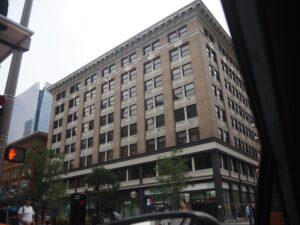
The Symes building at 820 16th St. on July 30, 2025. (Thomas Gounley/BusinessDen)
The DDA board voted to award Harbor Associates $17 million to help finance the building’s conversion. Choi said that’s the same amount the firm asked for.
“It’s hard to pencil without some financial support,” he said.
The Denver City Council will still need to sign off on the deal, as well as the other DDA appropriations announced Wednesday.
The plan is to turn the building’s office space into 116 residential units. The funds would also be used to improve the retail space and create a new outdoor patio.
Harbor first proposed converting the building in mid-2022. At the Wednesday press conference, Denver Chief Projects Officer Bill Mosher said that both expect to be under construction by next year. Asked separately about the timeline, Choi said only that the project to convert the Symes will lose its site development plan entitlements if it doesn’t break ground by July 2027.
He declined to discuss the total cost of the conversion, but said the DDA chunk is “definitely significant.” More work needs to be done to secure the remaining funds.
“Quite a bit more needs to fall into place,” Choi said.
Across the street, the 110,000-square-foot University Building dates to 1910 and has been owned for decades by the Denver-based Robert L. Naiman Co. In addition to traditional office tenants, its upper floors have historically been home to a number of retail jewelry shops. Its former smokestack has been painted to look like a pencil.
A different use for the University Building has been envisioned for years. In January 2020, Denver received plans calling for the structure to be converted into a hotel. But the subsequent pandemic battered the hospitality sector.
The University Building conversion is slated to get slightly less than the Symes, at $14.5 million. That would create 120 units, according to the city — about 10% more than were included in the initial conversion plans submitted to Denver last year.
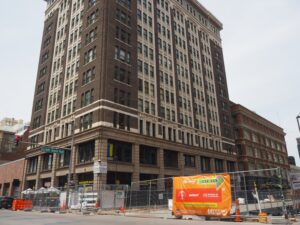
A 2024 photo of the University Building at 910 16th St. (BusinessDen file)
It would be developed by two local firms, George Thorn’s Mile High Development and Matt Joblon’s BMC Investments.
The Naimans would retain control of the retail space on the ground floor, Thorn said.
“We want the city to light up at night and the way to do that is to have people living downtown,” he said.
Public records show the group is also seeking $4.8 million in state and federal tax credits from the Colorado Housing and Finance Authority, along with $36.5 million in tax-exempt bonds. Units inside will be restricted to those making between 30% and 80% of the area median income.
“We’re all very happy about this but we’re not there yet,” Thorn cautioned. “We gotta get through the tax credit process with CHFA and we’ll be ready to go. We got all the other financing lined up.”
Since the pandemic, BusinessDen has reported on nine major proposals for office-to-residential conversions within Denver city limits. While none downtown are under construction, one in the Denver Tech Center is in progress. Shea Properties began converting the four-story, 124,000-square-foot building at 4340 S. Monaco St. after buying the property this spring. That deal is financed through a combination of private equity, $29 million in Denver-issued private activity bonds and an additional $4 million in federal and state tax credits.
BusinessDen staffer Matt Geiger contributed reporting.
The intersection of Champa and 16th streets in downtown Denver on July 30, 2025. (Thomas Gounley/BusinessDen)
Five years after the pandemic, downtown Denver has yet to see physical work begin on conversion of an office building into residences.
But on Wednesday, Denver said it’s ready to start putting money behind the idea.
Two conversion projects are among the 10 line items slated to get a combined $100 million in funding from the Downtown Development Authority.
“We have 7 million square feet of empty office space in downtown. That’s one problem to solve. We have a shortage of affordable housing across the city. It’s another problem to solve. This allows us to solve both of those at the same time,” Mayor Mike Johnston said at a Wednesday press conference.
The two buildings sit at the same intersection, where Champa Street meets the 16th Street Mall. On the south side is the eight-story Symes Building, sometimes called The George, at 820 16th St. To its north, at 910 16th St., is the 12-story University Building. Conversion plans call for the former to become mostly market-rate housing, while the latter would be fully income-restricted.
The 95,000-square-foot Symes is owned by Southern California-based Harbor Associates, which bought it in 2018 for $24.5 million expecting to keep it an office building.
“Pre-COVID, that was the plan. But post-COVID, we had to be nimble,” said Joon Choi, an executive with the firm.
Choi declined to discuss how leased the building is, but acknowledged, “We don’t have much.”
That’s not just on the office side. When Harbor bought the building, it had four ground-floor retail tenants: Famous Footwear, Sally Beauty Supply, 7-Eleven and Edible Arrangements. Only 7-Eleven is still there.
The Symes building at 820 16th St. on July 30, 2025. (Thomas Gounley/BusinessDen)
The DDA board voted to award Harbor Associates $17 million to help finance the building’s conversion. Choi said that’s the same amount the firm asked for.
“It’s hard to pencil without some financial support,” he said.
The Denver City Council will still need to sign off on the deal, as well as the other DDA appropriations announced Wednesday.
The plan is to turn the building’s office space into 116 residential units. The funds would also be used to improve the retail space and create a new outdoor patio.
Harbor first proposed converting the building in mid-2022. At the Wednesday press conference, Denver Chief Projects Officer Bill Mosher said that both expect to be under construction by next year. Asked separately about the timeline, Choi said only that the project to convert the Symes will lose its site development plan entitlements if it doesn’t break ground by July 2027.
He declined to discuss the total cost of the conversion, but said the DDA chunk is “definitely significant.” More work needs to be done to secure the remaining funds.
“Quite a bit more needs to fall into place,” Choi said.
Across the street, the 110,000-square-foot University Building dates to 1910 and has been owned for decades by the Denver-based Robert L. Naiman Co. In addition to traditional office tenants, its upper floors have historically been home to a number of retail jewelry shops. Its former smokestack has been painted to look like a pencil.
A different use for the University Building has been envisioned for years. In January 2020, Denver received plans calling for the structure to be converted into a hotel. But the subsequent pandemic battered the hospitality sector.
The University Building conversion is slated to get slightly less than the Symes, at $14.5 million. That would create 120 units, according to the city — about 10% more than were included in the initial conversion plans submitted to Denver last year.
A 2024 photo of the University Building at 910 16th St. (BusinessDen file)
It would be developed by two local firms, George Thorn’s Mile High Development and Matt Joblon’s BMC Investments.
The Naimans would retain control of the retail space on the ground floor, Thorn said.
“We want the city to light up at night and the way to do that is to have people living downtown,” he said.
Public records show the group is also seeking $4.8 million in state and federal tax credits from the Colorado Housing and Finance Authority, along with $36.5 million in tax-exempt bonds. Units inside will be restricted to those making between 30% and 80% of the area median income.
“We’re all very happy about this but we’re not there yet,” Thorn cautioned. “We gotta get through the tax credit process with CHFA and we’ll be ready to go. We got all the other financing lined up.”
Since the pandemic, BusinessDen has reported on nine major proposals for office-to-residential conversions within Denver city limits. While none downtown are under construction, one in the Denver Tech Center is in progress. Shea Properties began converting the four-story, 124,000-square-foot building at 4340 S. Monaco St. after buying the property this spring. That deal is financed through a combination of private equity, $29 million in Denver-issued private activity bonds and an additional $4 million in federal and state tax credits.
BusinessDen staffer Matt Geiger contributed reporting.