The first projects that could be funded by Denver’s expanded Downtown Development Authority, including two office-to-residential conversions, have been announced.
On Wednesday morning, Denver Mayor Mike Johnston detailed 10 projects that the DDA’s board unanimously approved to receive a combined $100 million in funding. The Denver City Council still needs to sign off on the deals.
“This is about moving Denver from a Central Business District to a central neighborhood district,” Johnston said.
Other speakers included the DDA board’s chairman, Douglas Tisdale, and Denver City Councilwoman Amanda Sandoval.
“We have another $475 million yet to go, and we have over 100 other applications in the pipeline today, and we keep on getting new ones,” Tisdale said at the announcement.
Here’s a roundup of the projects awarded DDA monies in the first round:
$30 million to activate Civic Center Park by investing in new infrastructure, lighting, garden walkways and tree canopy
$23 million for the DDA to purchase the two parking lots on both sides of Glenarm Place at 15th Street, by Denver Pavilions. The city says the acquisitions would offer “significant mixed use private redevelopment opportunities” as well as “opportunities to address affordable parking along 16th Street”
$17 million to help finance an office-to-residential conversion of the Symes Building at 820 16th St. that would create 116 residential units
$14.5 million toward an office-to-residential conversion of the University Building at 910 16th St. that would create 120 residential units
$7 million to “reimagine” the city-owned McNichols Building at 144 W. Colfax Ave., renovating the ground floor to create outdoor garden dining spaces, a full-service kitchen and an arts marketplace
$5 million to improve Skyline Park
$2.7 million for retail space for Green Spaces Market, which provides affordable retail and business space for artists, nonprofits and small businesses
$750,000 to expand Sundae Artisan Ice Cream’s flagship store on Glenarm Place
$640,000 to expand and relocate Milk Tea People, a cafe specializing in tea-based beverages, to a larger and more visible location along 16th Street. The cafe currently operates in the alley-like “paseo” within Market Station
$400,000 to renovate space for the Denver Immersive Repertory Theater
Additional projects are slated to be announced in the future.
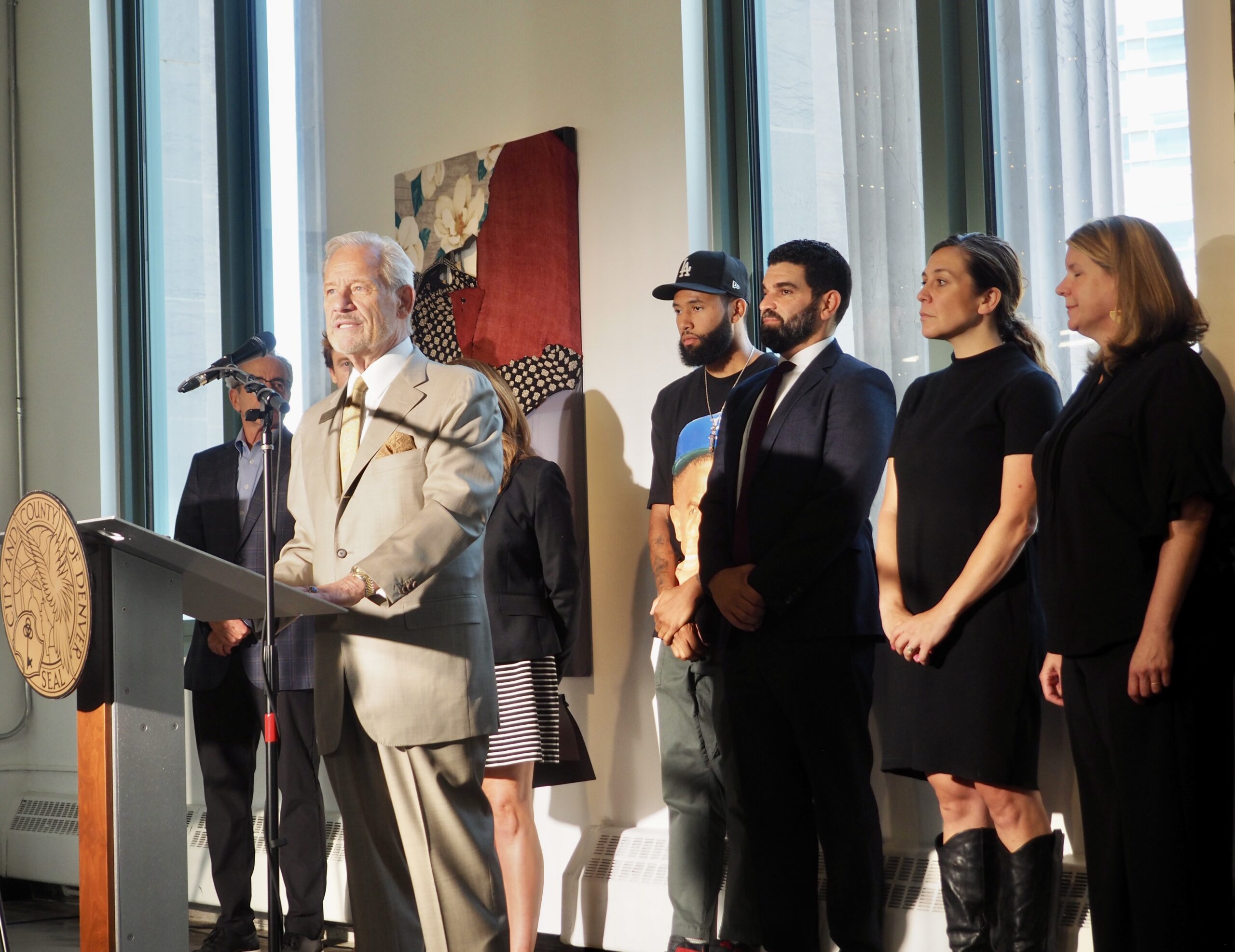
DDA board’s chairman, Douglas Tisdale, addresses the audience at Wednesday’s announcement. (Matt Geiger/BusinessDen)
Denver’s DDA was established in 2008 in connection with the redevelopment of Union Station. For years, it was a little-known taxing authority that captured a portion of property and sales taxes collected in that area and on the city block formerly home to the Regional Transportation District’s Market Street Station.
But last November — following a push by Johnston — property owners, residents and tenant businesses in that small area voted to expand the boundaries to include essentially the entire downtown and to authorize $570 million in bonds to fund projects.
Private recipients of the funds won’t have to repay the cash. Instead, the bonds will be repaid via tax increment financing, with the DDA — rather than the city directly — receiving the increased tax revenue that the new developments generate.
“These are not general fund dollars, these are not city dollars, these are not city capital dollars,” Mayor Johnston said. “These are dollars that are owned and cared for by the Downtown Development Authority, and they only have the legal approval to spend those dollars in this footprint that’s controlled by statute.”
City officials and downtown advocates hope the funds will help revitalize a downtown that has yet to rebound since the pandemic.
Office vacancy in the city’s center was 36.8% as of the second quarter, according to CBRE, and has steadily ticked upward since COVID. And years of city construction that redid the 16th Street Mall, now largely concluded, impacted foot traffic and retail sales along the pedestrian corridor.
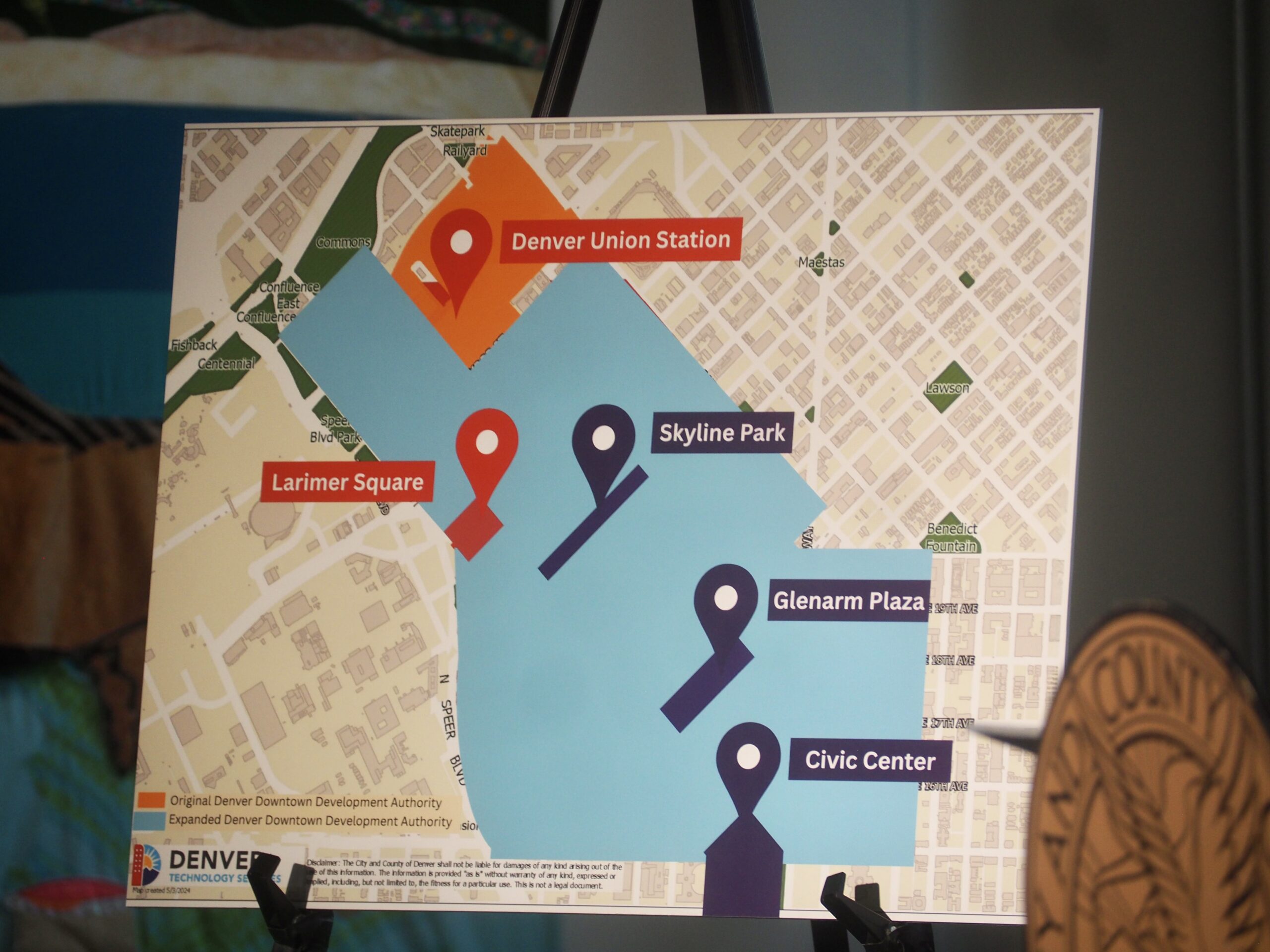
A map of the DDA’s boundaries was on display, which included some of the key project areas. (Matt Geiger/BusinessDen)
The first projects that could be funded by Denver’s expanded Downtown Development Authority, including two office-to-residential conversions, have been announced.
On Wednesday morning, Denver Mayor Mike Johnston detailed 10 projects that the DDA’s board unanimously approved to receive a combined $100 million in funding. The Denver City Council still needs to sign off on the deals.
“This is about moving Denver from a Central Business District to a central neighborhood district,” Johnston said.
Other speakers included the DDA board’s chairman, Douglas Tisdale, and Denver City Councilwoman Amanda Sandoval.
“We have another $475 million yet to go, and we have over 100 other applications in the pipeline today, and we keep on getting new ones,” Tisdale said at the announcement.
Here’s a roundup of the projects awarded DDA monies in the first round:
$30 million to activate Civic Center Park by investing in new infrastructure, lighting, garden walkways and tree canopy
$23 million for the DDA to purchase the two parking lots on both sides of Glenarm Place at 15th Street, by Denver Pavilions. The city says the acquisitions would offer “significant mixed use private redevelopment opportunities” as well as “opportunities to address affordable parking along 16th Street”
$17 million to help finance an office-to-residential conversion of the Symes Building at 820 16th St. that would create 116 residential units
$14.5 million toward an office-to-residential conversion of the University Building at 910 16th St. that would create 120 residential units
$7 million to “reimagine” the city-owned McNichols Building at 144 W. Colfax Ave., renovating the ground floor to create outdoor garden dining spaces, a full-service kitchen and an arts marketplace
$5 million to improve Skyline Park
$2.7 million for retail space for Green Spaces Market, which provides affordable retail and business space for artists, nonprofits and small businesses
$750,000 to expand Sundae Artisan Ice Cream’s flagship store on Glenarm Place
$640,000 to expand and relocate Milk Tea People, a cafe specializing in tea-based beverages, to a larger and more visible location along 16th Street. The cafe currently operates in the alley-like “paseo” within Market Station
$400,000 to renovate space for the Denver Immersive Repertory Theater
Additional projects are slated to be announced in the future.
DDA board’s chairman, Douglas Tisdale, addresses the audience at Wednesday’s announcement. (Matt Geiger/BusinessDen)
Denver’s DDA was established in 2008 in connection with the redevelopment of Union Station. For years, it was a little-known taxing authority that captured a portion of property and sales taxes collected in that area and on the city block formerly home to the Regional Transportation District’s Market Street Station.
But last November — following a push by Johnston — property owners, residents and tenant businesses in that small area voted to expand the boundaries to include essentially the entire downtown and to authorize $570 million in bonds to fund projects.
Private recipients of the funds won’t have to repay the cash. Instead, the bonds will be repaid via tax increment financing, with the DDA — rather than the city directly — receiving the increased tax revenue that the new developments generate.
“These are not general fund dollars, these are not city dollars, these are not city capital dollars,” Mayor Johnston said. “These are dollars that are owned and cared for by the Downtown Development Authority, and they only have the legal approval to spend those dollars in this footprint that’s controlled by statute.”
City officials and downtown advocates hope the funds will help revitalize a downtown that has yet to rebound since the pandemic.
Office vacancy in the city’s center was 36.8% as of the second quarter, according to CBRE, and has steadily ticked upward since COVID. And years of city construction that redid the 16th Street Mall, now largely concluded, impacted foot traffic and retail sales along the pedestrian corridor.
A map of the DDA’s boundaries was on display, which included some of the key project areas. (Matt Geiger/BusinessDen)