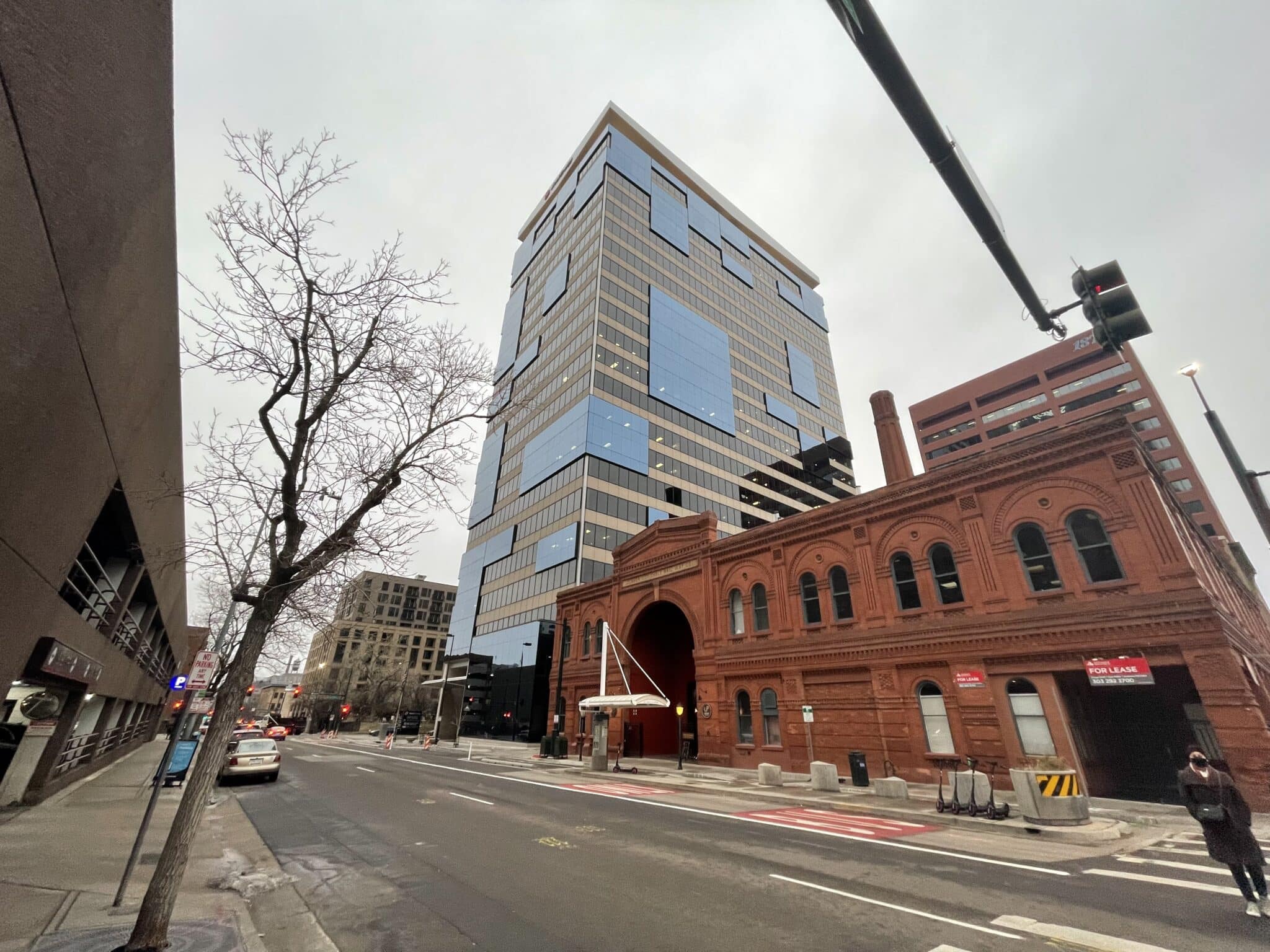
The 1800 Larimer St. office building in 2022. (BusinessDen file)
Office vacancy in downtown Denver ticked up again in the second quarter of 2025, largely because of Xcel Energy’s move to RiNo.
At the close of June, total office vacancy in the city center was 36.8%, according to CBRE. That was up 0.9 percentage points from the real estate brokerage’s first-quarter figure.
Total vacancy includes both direct vacancy, in which unused space is being marketed by a landlord, and space being marketed for sublease by a tenant. Downtown direct vacancy itself was 33.8% last quarter.
CBRE’s definition of “downtown” includes the Central Business District and LoDo, as well as LoHi’s Platte Street and a portion of Uptown. It doesn’t include RiNo, Cherry Creek or other spots farther afield.
Downtown saw negative net absorption of 270,000 square feet in the second quarter, according to CBRE, which means 270,000 more square feet were available at the end of June compared with the end of March.
Absorption would have been positive had it not been for Xcel’s decision to relocate its regional headquarters from downtown. The utility provider once had about 300,000 square feet at 1800 Larimer St. but moved earlier this year to all 220,000 office square feet in the T3 building at 3500 Blake St. in RiNo.
The 22-story 1800 Larimer building is now 75% vacant, according to LoopNet, which shows 405,000 square feet as available. Brokers representing the building did not respond to a request for comment.
Xcel’s impact on the numbers highlights the extent to which the state of downtown is linked to companies that occupy huge chunks of office space.
BusinessDen reported earlier this month that oil and gas giant EOG Resources, another major user, is eyeing a move from the Central Business District to LoDo that would shrink its footprint by about a third — adding an additional 50,000 square feet of downtown vacancy. And TIAA plans to shutter an office at 1670 Broadway that occupies hundreds of thousands of square feet.
The space isn’t easily filled, as fewer large office users are entering the Denver market. A local tech boom in the late 2010s, which saw out-of-state firms establish sizable offices locally, was largely derailed by the pandemic and remote work.
As always, there is nuance even within downtown. LoDo and Platte Street are relatively in demand, with total vacancy just 18.9% at the end of June, according to CBRE. But vacancy is greater than 40% in the Central Business District.
Similarly, the nicest “Class A” buildings downtown do better than average, with 31% total vacancy at the end of the quarter. That compares with 40.9% for Class B and C buildings.
There are office buildings beyond downtown, of course. Across the metro area, according to CBRE, total vacancy increased slightly to 27.4% last quarter, meaning downtown drags down the overall numbers.
A perennial bright spot? Cherry Creek, where total vacancy was 13.4% in the second quarter. And Boulder came in at 20.3%.
As for RiNo, the nascent office market where Xcel moved? Well, there’s plenty of room to join the company. Total vacancy there was 44.5% at the end of June.
But there’s 31 million square feet of office space downtown, according to CBRE, compared with about 3 million in each Cherry Creek and RiNo, and 6.5 million in Boulder.
The only other local submarket similar in size to downtown is the southeast submarket, which includes the Denver Tech Center and more suburban-style office properties. Total vacancy there was 26%.
The 1800 Larimer St. office building in 2022. (BusinessDen file)
Office vacancy in downtown Denver ticked up again in the second quarter of 2025, largely because of Xcel Energy’s move to RiNo.
At the close of June, total office vacancy in the city center was 36.8%, according to CBRE. That was up 0.9 percentage points from the real estate brokerage’s first-quarter figure.
Total vacancy includes both direct vacancy, in which unused space is being marketed by a landlord, and space being marketed for sublease by a tenant. Downtown direct vacancy itself was 33.8% last quarter.
CBRE’s definition of “downtown” includes the Central Business District and LoDo, as well as LoHi’s Platte Street and a portion of Uptown. It doesn’t include RiNo, Cherry Creek or other spots farther afield.
Downtown saw negative net absorption of 270,000 square feet in the second quarter, according to CBRE, which means 270,000 more square feet were available at the end of June compared with the end of March.
Absorption would have been positive had it not been for Xcel’s decision to relocate its regional headquarters from downtown. The utility provider once had about 300,000 square feet at 1800 Larimer St. but moved earlier this year to all 220,000 office square feet in the T3 building at 3500 Blake St. in RiNo.
The 22-story 1800 Larimer building is now 75% vacant, according to LoopNet, which shows 405,000 square feet as available. Brokers representing the building did not respond to a request for comment.
Xcel’s impact on the numbers highlights the extent to which the state of downtown is linked to companies that occupy huge chunks of office space.
BusinessDen reported earlier this month that oil and gas giant EOG Resources, another major user, is eyeing a move from the Central Business District to LoDo that would shrink its footprint by about a third — adding an additional 50,000 square feet of downtown vacancy. And TIAA plans to shutter an office at 1670 Broadway that occupies hundreds of thousands of square feet.
The space isn’t easily filled, as fewer large office users are entering the Denver market. A local tech boom in the late 2010s, which saw out-of-state firms establish sizable offices locally, was largely derailed by the pandemic and remote work.
As always, there is nuance even within downtown. LoDo and Platte Street are relatively in demand, with total vacancy just 18.9% at the end of June, according to CBRE. But vacancy is greater than 40% in the Central Business District.
Similarly, the nicest “Class A” buildings downtown do better than average, with 31% total vacancy at the end of the quarter. That compares with 40.9% for Class B and C buildings.
There are office buildings beyond downtown, of course. Across the metro area, according to CBRE, total vacancy increased slightly to 27.4% last quarter, meaning downtown drags down the overall numbers.
A perennial bright spot? Cherry Creek, where total vacancy was 13.4% in the second quarter. And Boulder came in at 20.3%.
As for RiNo, the nascent office market where Xcel moved? Well, there’s plenty of room to join the company. Total vacancy there was 44.5% at the end of June.
But there’s 31 million square feet of office space downtown, according to CBRE, compared with about 3 million in each Cherry Creek and RiNo, and 6.5 million in Boulder.
The only other local submarket similar in size to downtown is the southeast submarket, which includes the Denver Tech Center and more suburban-style office properties. Total vacancy there was 26%.