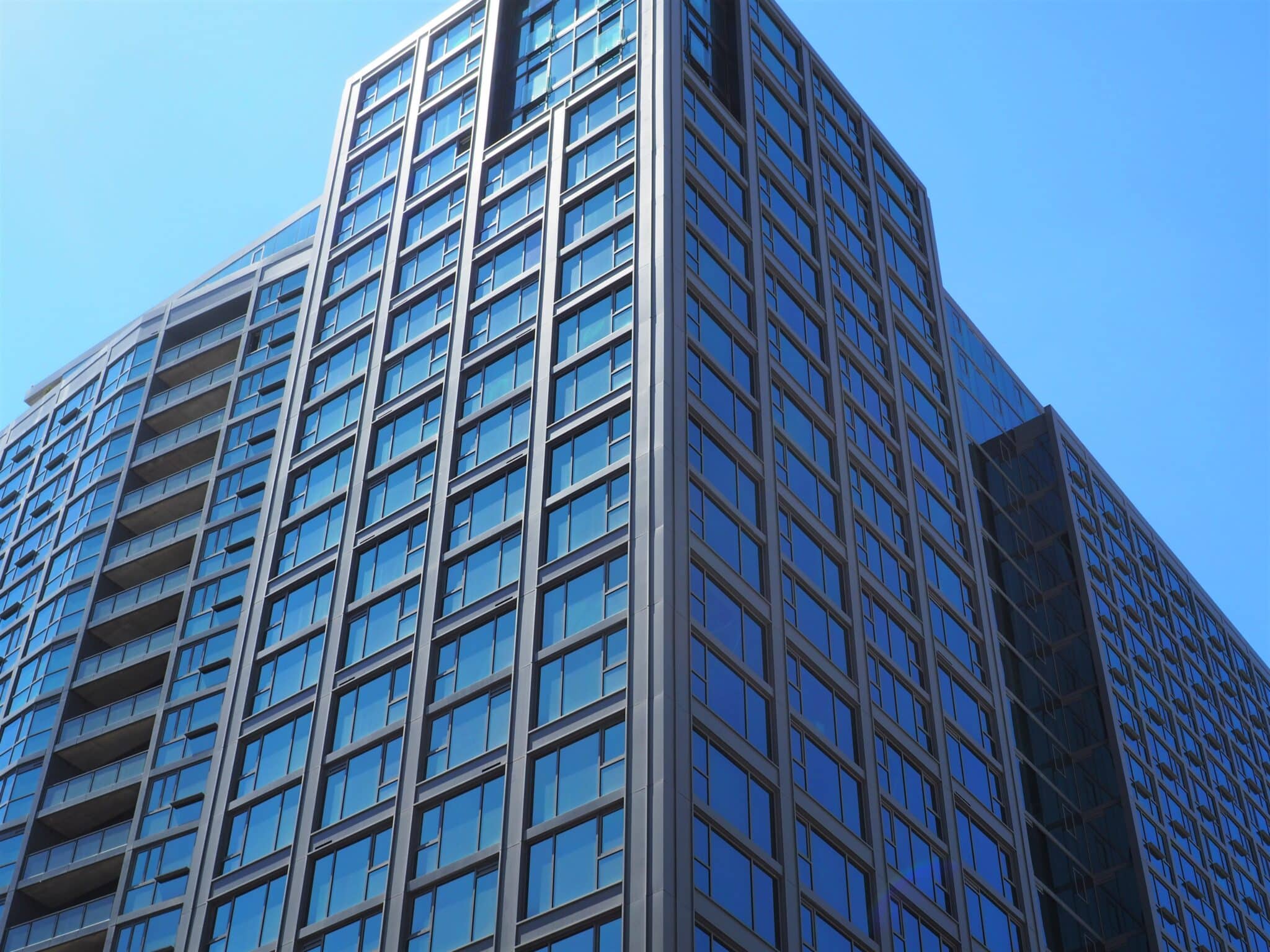
Landlords say many new buildings will have to raise rents to cover the loss of the common area maintenance fee, or eat the cost. Pictured are the Grand apartments at 1777 Chestnut Place. (BusinessDen file)
New legislation is changing how landlords calculate their rents in Colorado and likely cutting into their margins, at least temporarily.
House Bill 25-1090 took effect Jan. 1. The law’s objective is to improve price transparency across a variety of industries by making sellers advertise a total price that includes any applicable fees.
Landlords, many of whom have historically charged separate fees for things like parking and other amenities, are among those affected.
“It used to be if I was a housing provider, I could put a classified ad out there that said rent is $1,300, and then when you showed up to my door was the first time you learned … there’s $200 in mandatory fees in addition to that,” said Drew Hamrick, vice president of government affairs for the Apartment Association of Metro Denver.
The law also prohibits one type of landlord fee entirely: a common area maintenance/utility fee.
Landlords are allowed to increase base rent to offset the costs. But some may not do so, given higher than usual vacancy rates.
“The market’s soft right now, and has been soft for about three years, so I’m not sure that demand really supports those kinds of rent increases. So there will likely be a reduction in income associated with the common area utilities,” Hamrick said.
At the end of the third quarter, 6.6% of Denver apartments were vacant, up 0.8% compared with the same point in 2024, according to the apartment association. Concessions have hit a 15-year high. Rents are at their lowest in three years and a large apartment complex in RiNo was recently surrendered to a lender.
“The timing of this is unfortunate, that it’s going to narrow margins, or maybe even turn some projects that are struggling right now upside down, at least in the short term,” said Doug Elenowitz, co-founder of Denver developer Trailbreak Partners.
Elenowitz broke ground last spring on an 18-story apartment building called Kaia Residences at the corner of Eighth Avenue and Lincoln Street in Denver’s Cap Hill.
“In a building like Kaia, I think there’s just several years to see where all of this lands,” he said.
For a time, the industry believed the bill might cause even greater challenges for landlords, as many interpreted the law as banning all shared utilities. That would have meant that buildings with a single boiler or water tap couldn’t subdivide that charge to tenants.

Charlie Hogan (BusinessDen file)
“There was chaos in our industry,” said Charlie Hogan, CEO of large Denver property manager Cornerstone Apartment Services.
But in late November, Colorado Attorney General Phil Weiser sent out a memo clarifying that landlords can still charge tenants for shared utilities that serve their specific unit.
“Now we’ve got clarification from the attorney general’s office, and we’re expecting cleanup legislation to make that guidance clear,” Hamrick said.
Questions still remain, however, regarding what fees must be accounted for in the total price of an advertised unit. Not all tenants, for instance, need to pay a pet fee or parking fee.
“The bill says if the fee is necessary to enjoy the use of premises, that’s a mandatory fee. You can see different people have an interpretation of something like optional parking charges,” Hamrick said. “I suspect you’ll still see some variance from one total price to the next.”
At property manager Cornerstone, Hogan has decided to display fee sheets that show different charges and provide prospective tenants with an online calculator to determine how much their units will cost depending on what perks they want.
Despite the complexity, Hogan said the law is “actually a good thing” for Cornerstone because the company doesn’t charge as many additional fees compared to its competitors.
“We didn’t build our models with that stuff, those junk fees built into the underwriting, where they have,” he said.
Peter Culshaw, an executive with Shea Properties, is also a fan.
“I think transparency on what people are getting for their rent is a good thing,” he said.
Landlords say many new buildings will have to raise rents to cover the loss of the common area maintenance fee, or eat the cost. Pictured are the Grand apartments at 1777 Chestnut Place. (BusinessDen file)
New legislation is changing how landlords calculate their rents in Colorado and likely cutting into their margins, at least temporarily.
House Bill 25-1090 took effect Jan. 1. The law’s objective is to improve price transparency across a variety of industries by making sellers advertise a total price that includes any applicable fees.
Landlords, many of whom have historically charged separate fees for things like parking and other amenities, are among those affected.
“It used to be if I was a housing provider, I could put a classified ad out there that said rent is $1,300, and then when you showed up to my door was the first time you learned … there’s $200 in mandatory fees in addition to that,” said Drew Hamrick, vice president of government affairs for the Apartment Association of Metro Denver.
The law also prohibits one type of landlord fee entirely: a common area maintenance/utility fee.
Landlords are allowed to increase base rent to offset the costs. But some may not do so, given higher than usual vacancy rates.
“The market’s soft right now, and has been soft for about three years, so I’m not sure that demand really supports those kinds of rent increases. So there will likely be a reduction in income associated with the common area utilities,” Hamrick said.
At the end of the third quarter, 6.6% of Denver apartments were vacant, up 0.8% compared with the same point in 2024, according to the apartment association. Concessions have hit a 15-year high. Rents are at their lowest in three years and a large apartment complex in RiNo was recently surrendered to a lender.
“The timing of this is unfortunate, that it’s going to narrow margins, or maybe even turn some projects that are struggling right now upside down, at least in the short term,” said Doug Elenowitz, co-founder of Denver developer Trailbreak Partners.
Elenowitz broke ground last spring on an 18-story apartment building called Kaia Residences at the corner of Eighth Avenue and Lincoln Street in Denver’s Cap Hill.
“In a building like Kaia, I think there’s just several years to see where all of this lands,” he said.
For a time, the industry believed the bill might cause even greater challenges for landlords, as many interpreted the law as banning all shared utilities. That would have meant that buildings with a single boiler or water tap couldn’t subdivide that charge to tenants.
Charlie Hogan (BusinessDen file)
“There was chaos in our industry,” said Charlie Hogan, CEO of large Denver property manager Cornerstone Apartment Services.
But in late November, Colorado Attorney General Phil Weiser sent out a memo clarifying that landlords can still charge tenants for shared utilities that serve their specific unit.
“Now we’ve got clarification from the attorney general’s office, and we’re expecting cleanup legislation to make that guidance clear,” Hamrick said.
Questions still remain, however, regarding what fees must be accounted for in the total price of an advertised unit. Not all tenants, for instance, need to pay a pet fee or parking fee.
“The bill says if the fee is necessary to enjoy the use of premises, that’s a mandatory fee. You can see different people have an interpretation of something like optional parking charges,” Hamrick said. “I suspect you’ll still see some variance from one total price to the next.”
At property manager Cornerstone, Hogan has decided to display fee sheets that show different charges and provide prospective tenants with an online calculator to determine how much their units will cost depending on what perks they want.
Despite the complexity, Hogan said the law is “actually a good thing” for Cornerstone because the company doesn’t charge as many additional fees compared to its competitors.
“We didn’t build our models with that stuff, those junk fees built into the underwriting, where they have,” he said.
Peter Culshaw, an executive with Shea Properties, is also a fan.
“I think transparency on what people are getting for their rent is a good thing,” he said.