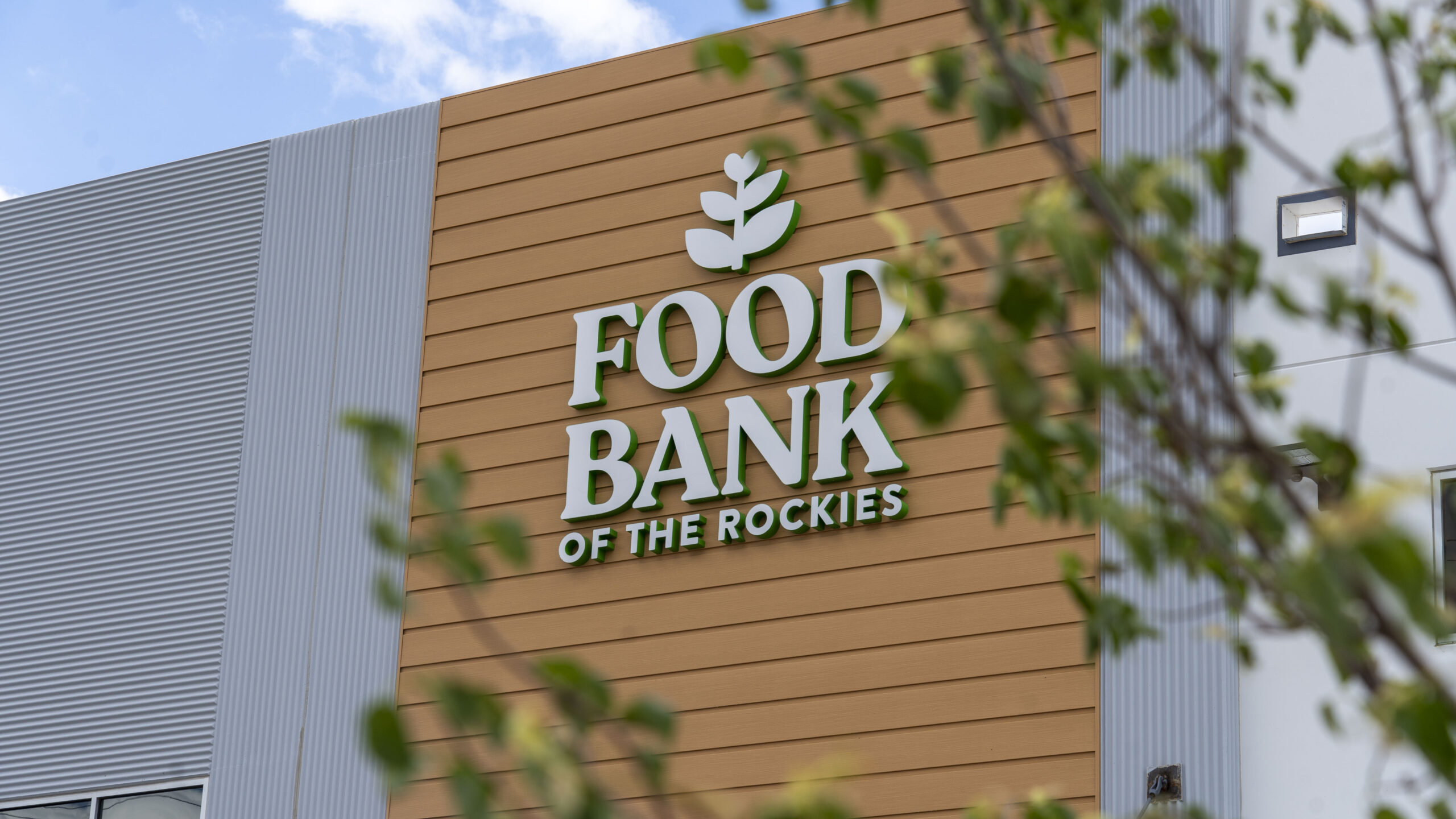
The Food Bank of the Rockies has been in its existing distribution center for nearly 20 years. (Provided by Food Bank of the Rockies)
With available space dwindling at his food bank’s distribution center, Steve Kullberg fashioned offices out of closets and conference rooms for the rapidly growing nonprofit.
“I called it Operation Shoebox. … I got as many as five people sharing one cubicle,” he said.
Kullberg has been chief of staff for the Food Bank of the Rockies since early 2020. The space constraints will soon be a non-issue: The organization has a new distribution center in the works in Aurora and Kullberg is overseeing its build-out.
That necessitated the sale of the food bank’s existing 103,000-square-foot facility at 10700 E. 45th Ave. in Denver’s Montbello neighborhood.
Earlier this month Denver Public Schools paid $12.5 million for the facility. DPS plans to use it for food service purposes.
The school district serves up 11 million meals per year. Its existing operations are spread out across leased properties not designed for cold storage, according to Scott Pribble, a DPS spokesman.
“The new facility will become the hub of our food services operations and a consolidated location for curriculum and furniture storage,” Pribble said in an email.
“It’s clearly one of the best possible uses for the property because it’s very similar use to what we’re doing,” Kullberg added.
The food bank, meanwhile, will move into its new 270,000-square-foot space at 20600 E. 38th Ave. in December. It cost $70 million to develop, but will allow the nonprofit to save $500,000 in yearly expenses and eventually distribute 100 million pounds of food annually, up from the 85 million it does now, Kullberg said.

The new food bank building when it was first under construction. (Provided by Food Bank of the Rockies)
The number of volunteers who can work on-site will be tripled, as will the amount of cold-storage space.
“Food banking, historically, was in cans,” Kullberg said. “That’s really dated. At this point about 65% of what we’re shipping is fresh or frozen. Lots and lots of fresh produce, things like protein, milk and yogurt.”
But getting to this point was not easy. Kullberg said he needed 15 acres of developable land, but also wanted to be near central Denver — two things that don’t often go hand-in-hand.
He looked at Pepsi’s old bottling plant in RiNo, but was turned away after getting told the land alone there was worth tens of millions. So his search went east.
“Warehouses are generally built in the Denver area for lease … we wanted to own it. So finding someone that would sell us land that was appropriate and plotted for this type of development was really difficult,” Kullberg said.
Ultimately, Aurora won out. The nonprofit chief of staff said the federal New Markets Tax Credit fund program provided “very large parts” of the development financing.
The food bank, founded in 1978, has a 150,000-square-mile distribution radius across Wyoming and Colorado, the largest in the U.S. outside Alaska.
The nonprofit gets about 10% of its food from public sources, 60% from retail stores and donations and buys the remaining 30% itself, according to Kullberg. After being sorted by volunteers, the food is shipped to one of 800 smaller “hunger-relief partners” where it ends up in the hands and mouths of those who need a good meal.
“We’ll have generally 180 to 200 items available on our online ordering system that our hunger-relief partners can draw from,” Kullberg said.
The Food Bank of the Rockies has been in its existing distribution center for nearly 20 years. (Provided by Food Bank of the Rockies)
With available space dwindling at his food bank’s distribution center, Steve Kullberg fashioned offices out of closets and conference rooms for the rapidly growing nonprofit.
“I called it Operation Shoebox. … I got as many as five people sharing one cubicle,” he said.
Kullberg has been chief of staff for the Food Bank of the Rockies since early 2020. The space constraints will soon be a non-issue: The organization has a new distribution center in the works in Aurora and Kullberg is overseeing its build-out.
That necessitated the sale of the food bank’s existing 103,000-square-foot facility at 10700 E. 45th Ave. in Denver’s Montbello neighborhood.
Earlier this month Denver Public Schools paid $12.5 million for the facility. DPS plans to use it for food service purposes.
The school district serves up 11 million meals per year. Its existing operations are spread out across leased properties not designed for cold storage, according to Scott Pribble, a DPS spokesman.
“The new facility will become the hub of our food services operations and a consolidated location for curriculum and furniture storage,” Pribble said in an email.
“It’s clearly one of the best possible uses for the property because it’s very similar use to what we’re doing,” Kullberg added.
The food bank, meanwhile, will move into its new 270,000-square-foot space at 20600 E. 38th Ave. in December. It cost $70 million to develop, but will allow the nonprofit to save $500,000 in yearly expenses and eventually distribute 100 million pounds of food annually, up from the 85 million it does now, Kullberg said.
The new food bank building when it was first under construction. (Provided by Food Bank of the Rockies)
The number of volunteers who can work on-site will be tripled, as will the amount of cold-storage space.
“Food banking, historically, was in cans,” Kullberg said. “That’s really dated. At this point about 65% of what we’re shipping is fresh or frozen. Lots and lots of fresh produce, things like protein, milk and yogurt.”
But getting to this point was not easy. Kullberg said he needed 15 acres of developable land, but also wanted to be near central Denver — two things that don’t often go hand-in-hand.
He looked at Pepsi’s old bottling plant in RiNo, but was turned away after getting told the land alone there was worth tens of millions. So his search went east.
“Warehouses are generally built in the Denver area for lease … we wanted to own it. So finding someone that would sell us land that was appropriate and plotted for this type of development was really difficult,” Kullberg said.
Ultimately, Aurora won out. The nonprofit chief of staff said the federal New Markets Tax Credit fund program provided “very large parts” of the development financing.
The food bank, founded in 1978, has a 150,000-square-mile distribution radius across Wyoming and Colorado, the largest in the U.S. outside Alaska.
The nonprofit gets about 10% of its food from public sources, 60% from retail stores and donations and buys the remaining 30% itself, according to Kullberg. After being sorted by volunteers, the food is shipped to one of 800 smaller “hunger-relief partners” where it ends up in the hands and mouths of those who need a good meal.
“We’ll have generally 180 to 200 items available on our online ordering system that our hunger-relief partners can draw from,” Kullberg said.