The first dorm serving the Metropolitan State University of Denver is poised to break ground this September, and construction could begin on another building next door months later.
The construction of two buildings on a 2-acre former ballfield site along Auraria Parkway has been anticipated for years. Last week, plans for the first building were approved by the board of the Auraria Campus, the organization that oversees the three-university campus adjacent to downtown Denver.
“This mixed-use project means everything to the future of Auraria,” said Auraria Campus CEO Colleen Walker.
The residence hall breaking ground in September will be 12 stories and have 550 beds. The $117 million project will come with retail on the first floor and a student-serving “classroom-to-career hub” above it. While it will be the first on-campus housing for MSU Denver, it won’t be the first on the Auraria campus, as the University of Colorado Denver already has housing.
The second building, planned right next door, could break ground early next year. The $120 million, 12-story project will have about 300 income-restricted apartments, but they won’t be specifically reserved for MSU Denver students.
The buildings will be the campus’ tallest. They’ll go up along Auraria Parkway between a parking garage and 11th and Walnut streets on the site of MSU Denver’s former ballfield, which moved in 2015.
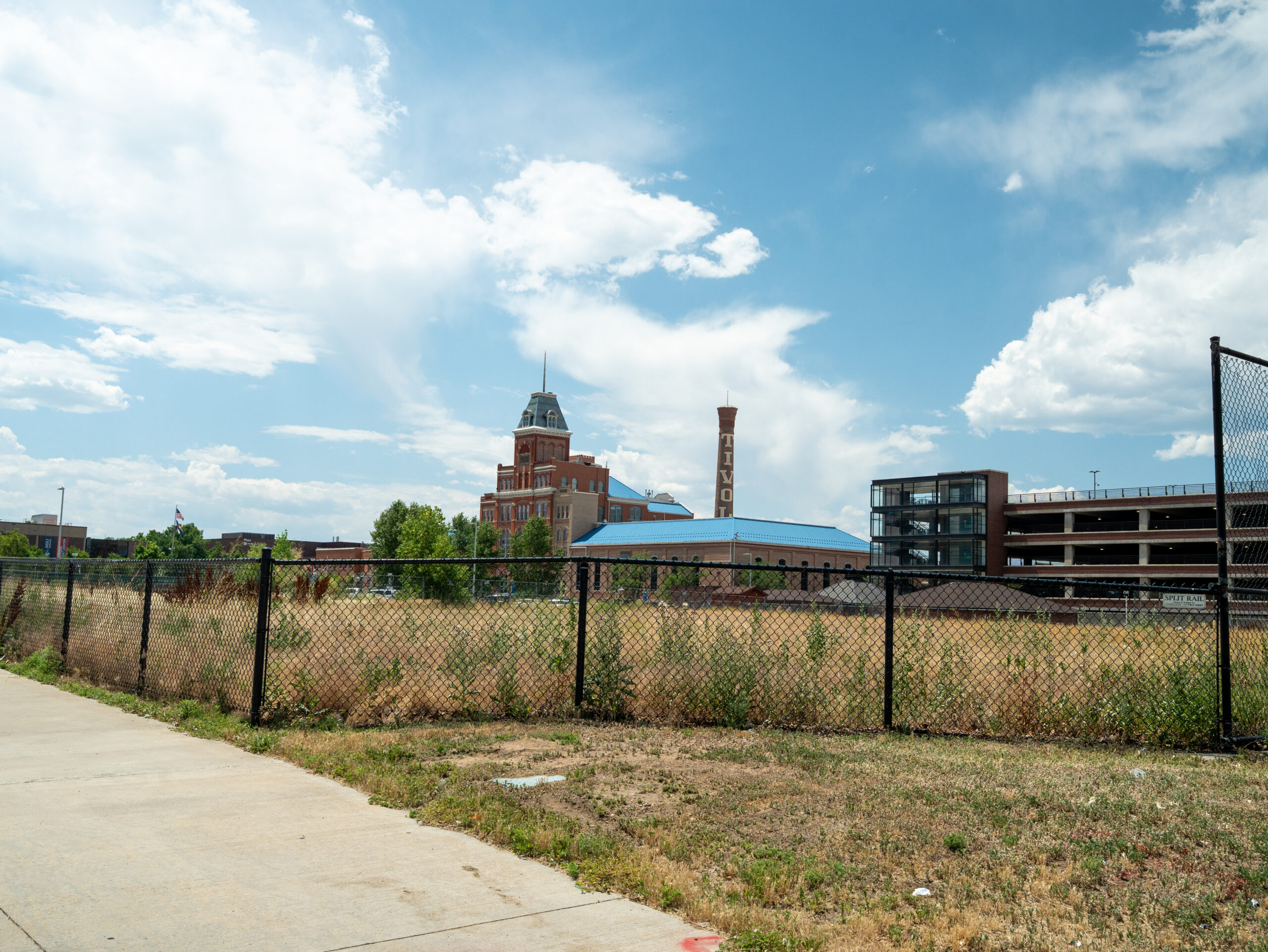
The site of the two planned buildings is currently a vacant lot. (Hayden Kim/BusinessDen)
It’s all part of what Walker is calling Auraria 3.0.
From the time campus opened in 1976 to about a decade ago, most buildings were shared by all three schools. Then, in Auraria 2.0, each institution began to move to its own area. MSU Denver got Auraria Parkway, the University of Colorado Denver got Speer Boulevard and the Community College of Denver got Colfax Avenue.
But campus has become too spread out, Walker said. It’s quiet on weekends and evenings. Surface lots and empty fields dot its 150 acres. When campus grinded to a halt in 2020, Walker saw Auraria’s vulnerability.
“Fifty years in, we can no longer do the urban sprawl,” Walker said. “We have to do vertical, high-density use.”
So, enter the ballfield project.
“When we look at national data, what we know is that when there’s student housing programs on physical campuses, that students tend to do and perform better academically. And so that’s really the intersection of why we made this decision,” said Taylor Tackett, MSU Denver’s dean of students.
Tackett said 70% of students surveyed indicated they’d live on campus if given the option to do so, and some commute from as far as two hours away.
But financing a project that involves multiple public institutions and uses is not so straightforward. Construction of the residence hall and retail portion will be financed by MSU Denver-issued debt, serviced entirely by revenue from the building to avoid any change in tuition. The second-floor career hub is funded with $6 million in state money and $9.6 million in philanthropic dollars, MSU Denver Chief Financial Officer Jim Carpenter said.
“I’ve never financed a deal, specifically a housing component of a deal, 100% through public debt,” said Iván Anaya, president of the Mountain West region for Columbia Ventures, the Georgia-based developer building the project.
The second building’s details are still being ironed out, Anaya said. But it will include the campus’s early learning center on the first and part of the second floor.
The center has been around since Auraria’s inception in the 1970s, providing care and an academic program for children of faculty, students and staff while they’re at work. Auraria CEO Walker said the center has about 90 families on its waiting list at any given time, so this expansion will meet that demand.
Financing for the second building is about 45% complete, she added. The early learning center’s $15.7 million cost is already funded by a mix of federal and state grants, philanthropic money and university investment.
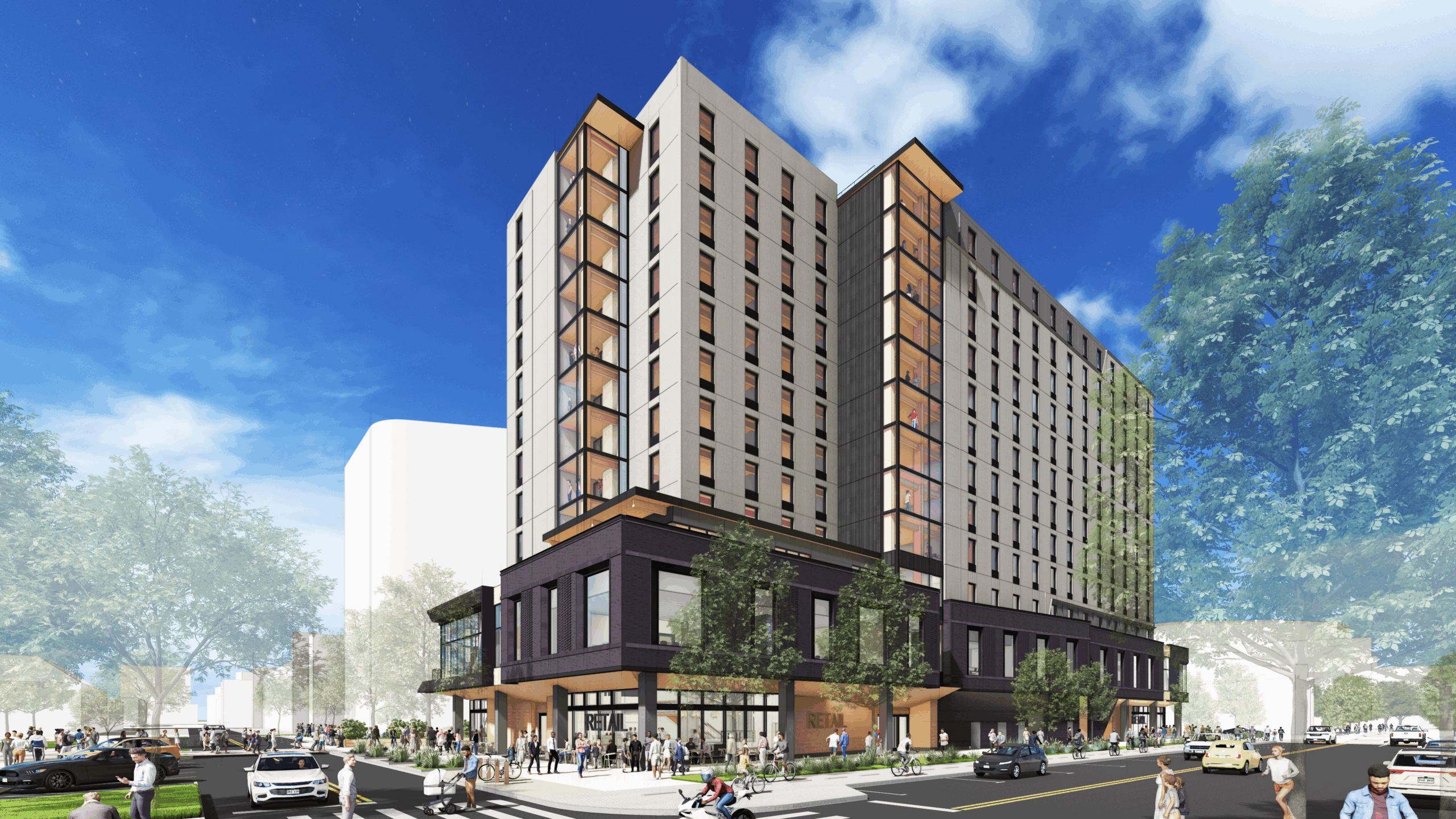
A rendering of the residence hall. (Courtesy Columbia Ventures)
All of this fundraising and planning is occurring during one of the most tumultuous times in recent memory for capital markets and construction costs, with public institutions more heavily regulated than private counterparts.
“That was front of mind when we were going through building material selection, understanding what materiality had higher risks, tariff risks, domestic, just supply and demand risk, and that really did help lead to mass timber as another benefit,” said Ben Diaz, development manager for Columbia Ventures.
The mass timber Diaz refers to is the skeleton of the residence hall building, built entirely with a wood frame. While typically more expensive than its concrete and steel counterparts, market conditions and a good relationship with general contractor PCL Construction brought down costs substantially.
In all, tariffs only increased the building expenses by about 2%, Diaz said. Diaz and Anaya believe it will be the largest mass timber building in the state. It was designed by Shears Adkins Rockmore Architects, the firm working on the major redevelopment of nearby Ball Arena’s parking lots.
“We’ve been building buildings the same way for the last 150 years, and there’s a lot of things that are changing and I think that this building epitomizes a lot of what is coming in the future,” Anaya said.
It also shines a light on the future of Auraria.
The campus recently completed a “campus framework” plan that outlines future growth. The documents say 52 of Auraria’s 150 acres are suitable for future development.
Walker identified two potential projects that could occur in the short term. One, a state Hispanic heritage museum, is contemplated for a small parcel, about 50 feet wide and 300 feet deep, located between the two forthcoming buildings and an existing SpringHill Suites hotel.
On the other end of campus is the Regional Transportation District’s Auraria West Station, a light rail stop. Despite being one of the network’s busiest, Walker said, it is surrounded by a sea of parking lots and vacant land, ripe for a large transit-oriented development.
Walker understands that her campus will be surrounded by other big-time projects. To the north is Ball Arena and its parking lots, along with the River Mile project destined to someday replace Elitch Gardens. And to the south of campus sits Burnham Yard, the state-owned railyard the Denver Broncos are eyeing for a new stadium.
“Interestingly enough, we’re going to be one of the first movers,” Walker said. “We’re ahead of River Mile, we’re ahead of Ball and we’re ahead of Burnham. No one could have known that to be the case five years ago.”
The first dorm serving the Metropolitan State University of Denver is poised to break ground this September, and construction could begin on another building next door months later.
The construction of two buildings on a 2-acre former ballfield site along Auraria Parkway has been anticipated for years. Last week, plans for the first building were approved by the board of the Auraria Campus, the organization that oversees the three-university campus adjacent to downtown Denver.
“This mixed-use project means everything to the future of Auraria,” said Auraria Campus CEO Colleen Walker.
The residence hall breaking ground in September will be 12 stories and have 550 beds. The $117 million project will come with retail on the first floor and a student-serving “classroom-to-career hub” above it. While it will be the first on-campus housing for MSU Denver, it won’t be the first on the Auraria campus, as the University of Colorado Denver already has housing.
The second building, planned right next door, could break ground early next year. The $120 million, 12-story project will have about 300 income-restricted apartments, but they won’t be specifically reserved for MSU Denver students.
The buildings will be the campus’ tallest. They’ll go up along Auraria Parkway between a parking garage and 11th and Walnut streets on the site of MSU Denver’s former ballfield, which moved in 2015.
The site of the two planned buildings is currently a vacant lot. (Hayden Kim/BusinessDen)
It’s all part of what Walker is calling Auraria 3.0.
From the time campus opened in 1976 to about a decade ago, most buildings were shared by all three schools. Then, in Auraria 2.0, each institution began to move to its own area. MSU Denver got Auraria Parkway, the University of Colorado Denver got Speer Boulevard and the Community College of Denver got Colfax Avenue.
But campus has become too spread out, Walker said. It’s quiet on weekends and evenings. Surface lots and empty fields dot its 150 acres. When campus grinded to a halt in 2020, Walker saw Auraria’s vulnerability.
“Fifty years in, we can no longer do the urban sprawl,” Walker said. “We have to do vertical, high-density use.”
So, enter the ballfield project.
“When we look at national data, what we know is that when there’s student housing programs on physical campuses, that students tend to do and perform better academically. And so that’s really the intersection of why we made this decision,” said Taylor Tackett, MSU Denver’s dean of students.
Tackett said 70% of students surveyed indicated they’d live on campus if given the option to do so, and some commute from as far as two hours away.
But financing a project that involves multiple public institutions and uses is not so straightforward. Construction of the residence hall and retail portion will be financed by MSU Denver-issued debt, serviced entirely by revenue from the building to avoid any change in tuition. The second-floor career hub is funded with $6 million in state money and $9.6 million in philanthropic dollars, MSU Denver Chief Financial Officer Jim Carpenter said.
“I’ve never financed a deal, specifically a housing component of a deal, 100% through public debt,” said Iván Anaya, president of the Mountain West region for Columbia Ventures, the Georgia-based developer building the project.
The second building’s details are still being ironed out, Anaya said. But it will include the campus’s early learning center on the first and part of the second floor.
The center has been around since Auraria’s inception in the 1970s, providing care and an academic program for children of faculty, students and staff while they’re at work. Auraria CEO Walker said the center has about 90 families on its waiting list at any given time, so this expansion will meet that demand.
Financing for the second building is about 45% complete, she added. The early learning center’s $15.7 million cost is already funded by a mix of federal and state grants, philanthropic money and university investment.
A rendering of the residence hall. (Courtesy Columbia Ventures)
All of this fundraising and planning is occurring during one of the most tumultuous times in recent memory for capital markets and construction costs, with public institutions more heavily regulated than private counterparts.
“That was front of mind when we were going through building material selection, understanding what materiality had higher risks, tariff risks, domestic, just supply and demand risk, and that really did help lead to mass timber as another benefit,” said Ben Diaz, development manager for Columbia Ventures.
The mass timber Diaz refers to is the skeleton of the residence hall building, built entirely with a wood frame. While typically more expensive than its concrete and steel counterparts, market conditions and a good relationship with general contractor PCL Construction brought down costs substantially.
In all, tariffs only increased the building expenses by about 2%, Diaz said. Diaz and Anaya believe it will be the largest mass timber building in the state. It was designed by Shears Adkins Rockmore Architects, the firm working on the major redevelopment of nearby Ball Arena’s parking lots.
“We’ve been building buildings the same way for the last 150 years, and there’s a lot of things that are changing and I think that this building epitomizes a lot of what is coming in the future,” Anaya said.
It also shines a light on the future of Auraria.
The campus recently completed a “campus framework” plan that outlines future growth. The documents say 52 of Auraria’s 150 acres are suitable for future development.
Walker identified two potential projects that could occur in the short term. One, a state Hispanic heritage museum, is contemplated for a small parcel, about 50 feet wide and 300 feet deep, located between the two forthcoming buildings and an existing SpringHill Suites hotel.
On the other end of campus is the Regional Transportation District’s Auraria West Station, a light rail stop. Despite being one of the network’s busiest, Walker said, it is surrounded by a sea of parking lots and vacant land, ripe for a large transit-oriented development.
Walker understands that her campus will be surrounded by other big-time projects. To the north is Ball Arena and its parking lots, along with the River Mile project destined to someday replace Elitch Gardens. And to the south of campus sits Burnham Yard, the state-owned railyard the Denver Broncos are eyeing for a new stadium.
“Interestingly enough, we’re going to be one of the first movers,” Walker said. “We’re ahead of River Mile, we’re ahead of Ball and we’re ahead of Burnham. No one could have known that to be the case five years ago.”