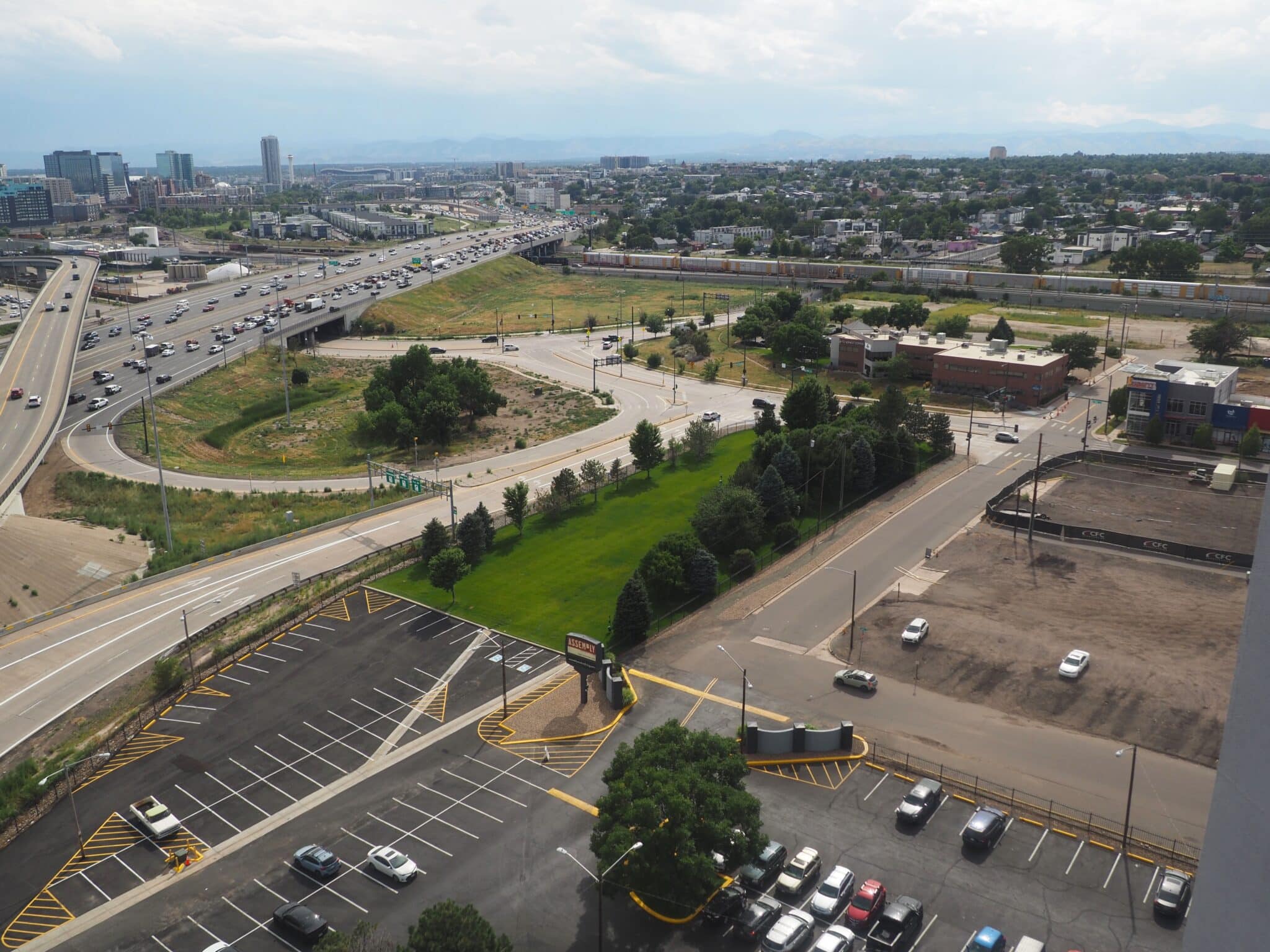
A 2023 view of the southern end of Fox Island, as seen from the roof of the Assembly Student Living apartment building. (BusinessDen file)
The second-largest property owner in Fox Island is suing Denver in hopes of dismantling the trip cap, a restriction on new development that is found nowhere else in the city.
In a Dec. 23 lawsuit, a subsidiary of Rob Salazar’s Central Street Capital argues that the rules affecting the 185-acre pocket of Globeville are “unconstitutionally vague” and a result of the city’s own failures.
“For decades, the City has failed to invest in sufficient public traffic infrastructure in the Globeville neighborhood, one of Denver’s most economically disadvantaged neighborhoods,” the company’s lawsuit reads. “Instead, the City adopted development rules … that attempt to completely and unlawfully shift this burden to the last-in-time developers trying to build housing in the neighborhood.”
The lawsuit filed in U.S. District Court comes eight years after Denver implemented the rules to manage the growth of vehicle trips in an urban island surrounded not by water but by transportation corridors.
A spokeswoman for the city attorney’s office, which has yet to respond in court, declined to comment.
Worries of gridlock, and a unique restriction
To the north of Fox Island is Interstate 70. To the east and south is Interstate 25. To the west are railroad tracks. Fox Street is the one main road that traverses it.
There are just two spots to enter and exit the area by car.
For a while, Fox Island was a largely industrial neighborhood, with some older homes and one tower right up against I-25.
In 2019, however, the neighborhood got an RTD rail station, making Fox Island a natural area for denser residential development — something Denver generally encourages. And new apartments have indeed been built.
But Denver is also worried about more people living, and likely driving cars, in Fox Island.
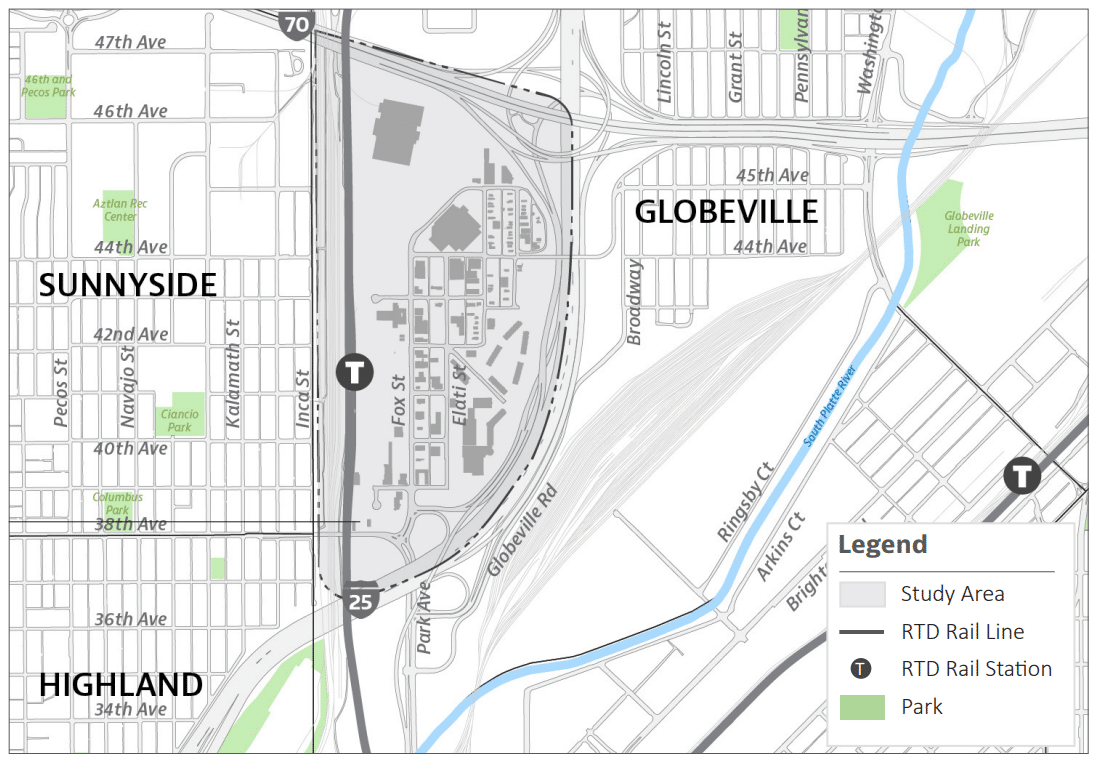
A map shows the boundaries of Fox Island in gray. (City of Denver)
In 2023, Chris Nevitt, Denver’s manager for transit-oriented development, said that, given the limited access points, the city is wary of new development creating “catastrophic gridlock,” where emergency services can’t get into Fox Island. There is no police station within it. Nor is there a fire station.
So, in 2018, with the RTD station on the way, the rules were implemented. They stated that, for a time, Fox Island would be limited to 25,000 trips.
Trips are somewhat hypothetical but represent each time a vehicle crosses the neighborhood’s boundaries. A resident driving to the suburbs for work and arriving home eight hours later, for example, would be two trips.
Buildings that already existed then were awarded trips. And developers were told they could erect new buildings only after being awarded a number of trips corresponding to how much additional vehicle traffic they were expected to generate.
At the start, 12,995 trips were available for developers. Five years later, they ran out.
“We have used up all the available trips,” Nevitt said in 2023.
Denver did establish a path for more trips to become available when new or improved vehicle infrastructure is put in place.
But Denver isn’t putting in that infrastructure. Instead, it is having developers in the area build it, or at least pay for it, in exchange for their own projects getting more trips. Most notably, the owner of a former Denver Post printing facility — the only property owner with greater holdings than Central Street — has agreed to someday build a bridge over the railroad tracks to neighboring Sunnyside.

Rob Salazar
Property owner in neighborhood since 2004
Central Street Capital is a family office established by Salazar, a health care entrepreneur. It has developed an apartment building in LoHi, bought a Lakewood office building on the cheap and has a retail-focused project underway in Glendale.
But Fox Island has been a major focus for the company.
Central Street has been in the neighborhood since 2004, when it purchased the former Regency Hotel and turned it into the Assembly Student Living apartment complex. It built retail space on one corner of 39th Avenue and Fox Street last decade and bought a low-slung hotel across the street in 2020, then demolished it.
The company recently completed a new apartment building at 4040 Fox St. It was awarded trips for that. But it’s known for years that additional construction would be difficult.
“We’re basically hitting the brakes on what we can develop in the neighborhood,” Isiah Salazar, Rob’s son and Central Street’s president, said in 2023.
Central Street also owns a 0.68-acre vacant lot between the former hotel and Assembly Student Living, which it bought in 2007. The subsidiary that owns that lot, 3901 Elati St., is what technically sued the city.
In December 2024, Central Street submitted plans to the city proposing a 20-story apartment building with more than 400 units on the lot.
But with no trips available, it can’t build the project.
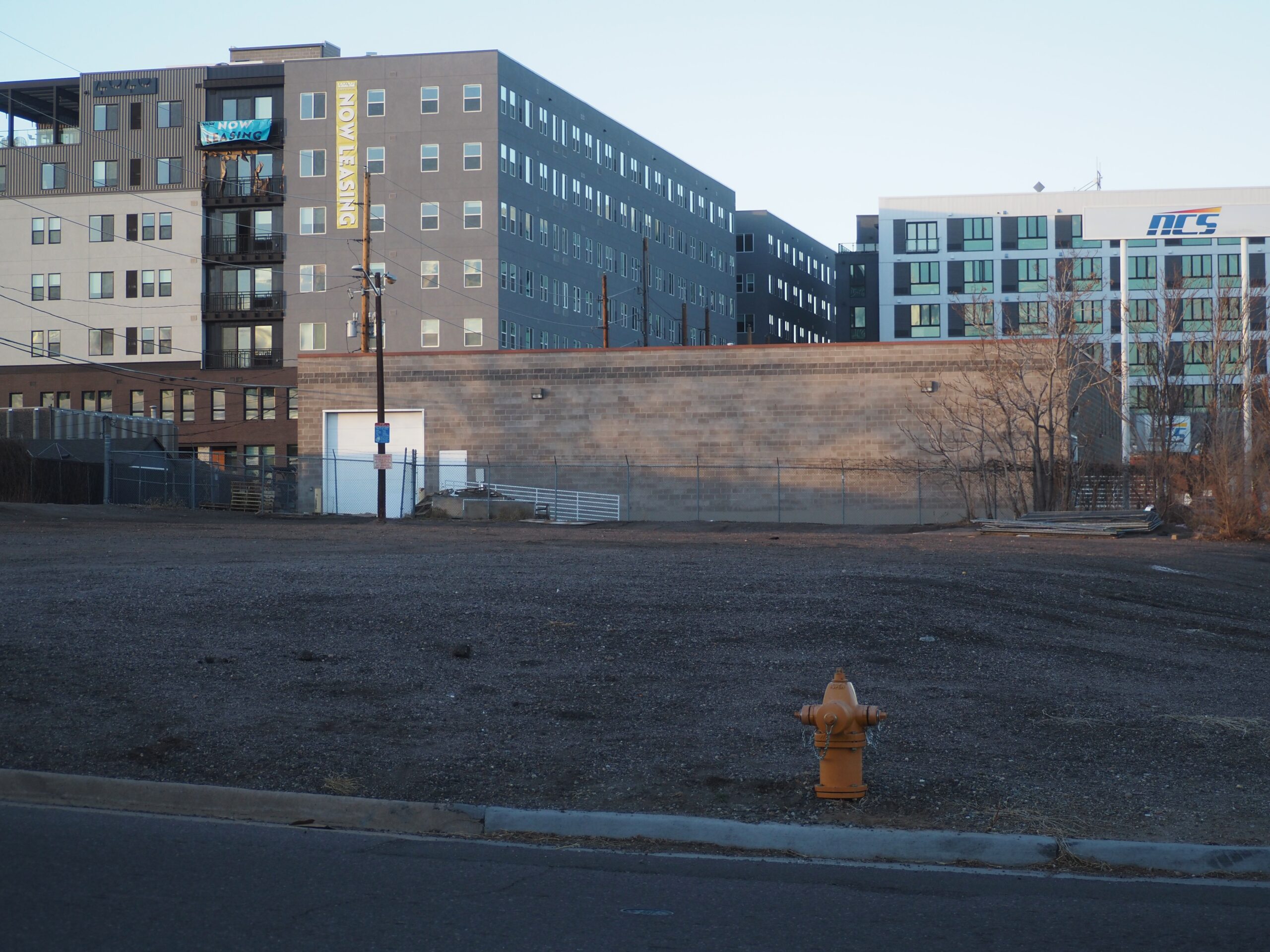
The vacant 3901 Elati St. lot on Jan. 5, 2026. At left in the background is an apartment building that Central Street Capital recently completed at 4040 Fox St. (Thomas Gounley/BusinessDen)
City’s process unclear and arbitrary, lawsuit argues
In the lawsuit, Central says it expected, while reviewing the conceptual plan for 3901 Fox St., that city staff might identify infrastructure improvements that Central could undertake to earn trips.
But that did not happen.
The company says it “is now faced with the impossible choice to either drop the Project entirely or to incur tens of thousands of dollars in engineering costs to design distant public traffic improvements to maybe be awarded sufficient Trips from the City.”
Among the company’s objections is that Denver does not specify how it decides how many trips a possible improvement might be worth. And the number of trips can be modified even after the developer completes the improvements, according to Central Street’s lawsuit.
In one case, according to Central Street, a city official told a landowner that it might earn 2,500 trips if it spent tens of millions of dollars building a city fire station in Fox Island.
“Even in suggesting this possibility, however, the City official indicated that multiple other unnamed ‘experts’ within the City would need to review this approval and assign Trips for this multimillion-dollar public dedication,” Central Street lawsuit says. “The City could not point to any rules or guidelines for how that review process would actually play out.”

Isiah Salazar
Denver’s assessor values the 3901 Elati St. lot at $3.4 million. Central Street argues that the trip restrictions render it worthless.
“The Rules arbitrarily create winners and losers depending on the timing of development rather than requiring all land users to support needed infrastructure,” the company’s lawsuit states.
Central Street is asking the court to declare the rules unconstitutional and tell Denver it can’t enforce them.
Central Street is represented by Ireland Stapleton attorneys Benjamin Larson, James Silvestro and Jonathan Brummet.
Salazars have suit pending against Lakewood bank, Glendale
Central Street and the Salazars are not afraid to go to court. Two other cases they’re involved in are pending.
Last March, Central Street sued Glendale, where the company has been building infrastructure for a 10-acre Alamo Drafthouse-anchored project, arguing that the city breached its contract in connection with a planned transfer of the land. Last week, a judge denied Glendale’s request to dismiss the case.
And in 2023, Rob Salazar sued the single-branch Solera Bank in Lakewood, accusing the bank’s majority owner of squandering profit on aircraft. A judge granted Salazar’s request to inspect certain records, but the lawsuit continues.
Correction: This story has been updated to reflect the last development in Central Street’s lawsuit against Glendale.
A 2023 view of the southern end of Fox Island, as seen from the roof of the Assembly Student Living apartment building. (BusinessDen file)
The second-largest property owner in Fox Island is suing Denver in hopes of dismantling the trip cap, a restriction on new development that is found nowhere else in the city.
In a Dec. 23 lawsuit, a subsidiary of Rob Salazar’s Central Street Capital argues that the rules affecting the 185-acre pocket of Globeville are “unconstitutionally vague” and a result of the city’s own failures.
“For decades, the City has failed to invest in sufficient public traffic infrastructure in the Globeville neighborhood, one of Denver’s most economically disadvantaged neighborhoods,” the company’s lawsuit reads. “Instead, the City adopted development rules … that attempt to completely and unlawfully shift this burden to the last-in-time developers trying to build housing in the neighborhood.”
The lawsuit filed in U.S. District Court comes eight years after Denver implemented the rules to manage the growth of vehicle trips in an urban island surrounded not by water but by transportation corridors.
A spokeswoman for the city attorney’s office, which has yet to respond in court, declined to comment.
Worries of gridlock, and a unique restriction
To the north of Fox Island is Interstate 70. To the east and south is Interstate 25. To the west are railroad tracks. Fox Street is the one main road that traverses it.
There are just two spots to enter and exit the area by car.
For a while, Fox Island was a largely industrial neighborhood, with some older homes and one tower right up against I-25.
In 2019, however, the neighborhood got an RTD rail station, making Fox Island a natural area for denser residential development — something Denver generally encourages. And new apartments have indeed been built.
But Denver is also worried about more people living, and likely driving cars, in Fox Island.
A map shows the boundaries of Fox Island in gray. (City of Denver)
In 2023, Chris Nevitt, Denver’s manager for transit-oriented development, said that, given the limited access points, the city is wary of new development creating “catastrophic gridlock,” where emergency services can’t get into Fox Island. There is no police station within it. Nor is there a fire station.
So, in 2018, with the RTD station on the way, the rules were implemented. They stated that, for a time, Fox Island would be limited to 25,000 trips.
Trips are somewhat hypothetical but represent each time a vehicle crosses the neighborhood’s boundaries. A resident driving to the suburbs for work and arriving home eight hours later, for example, would be two trips.
Buildings that already existed then were awarded trips. And developers were told they could erect new buildings only after being awarded a number of trips corresponding to how much additional vehicle traffic they were expected to generate.
At the start, 12,995 trips were available for developers. Five years later, they ran out.
“We have used up all the available trips,” Nevitt said in 2023.
Denver did establish a path for more trips to become available when new or improved vehicle infrastructure is put in place.
But Denver isn’t putting in that infrastructure. Instead, it is having developers in the area build it, or at least pay for it, in exchange for their own projects getting more trips. Most notably, the owner of a former Denver Post printing facility — the only property owner with greater holdings than Central Street — has agreed to someday build a bridge over the railroad tracks to neighboring Sunnyside.
Rob Salazar
Property owner in neighborhood since 2004
Central Street Capital is a family office established by Salazar, a health care entrepreneur. It has developed an apartment building in LoHi, bought a Lakewood office building on the cheap and has a retail-focused project underway in Glendale.
But Fox Island has been a major focus for the company.
Central Street has been in the neighborhood since 2004, when it purchased the former Regency Hotel and turned it into the Assembly Student Living apartment complex. It built retail space on one corner of 39th Avenue and Fox Street last decade and bought a low-slung hotel across the street in 2020, then demolished it.
The company recently completed a new apartment building at 4040 Fox St. It was awarded trips for that. But it’s known for years that additional construction would be difficult.
“We’re basically hitting the brakes on what we can develop in the neighborhood,” Isiah Salazar, Rob’s son and Central Street’s president, said in 2023.
Central Street also owns a 0.68-acre vacant lot between the former hotel and Assembly Student Living, which it bought in 2007. The subsidiary that owns that lot, 3901 Elati St., is what technically sued the city.
In December 2024, Central Street submitted plans to the city proposing a 20-story apartment building with more than 400 units on the lot.
But with no trips available, it can’t build the project.
The vacant 3901 Elati St. lot on Jan. 5, 2026. At left in the background is an apartment building that Central Street Capital recently completed at 4040 Fox St. (Thomas Gounley/BusinessDen)
City’s process unclear and arbitrary, lawsuit argues
In the lawsuit, Central says it expected, while reviewing the conceptual plan for 3901 Fox St., that city staff might identify infrastructure improvements that Central could undertake to earn trips.
But that did not happen.
The company says it “is now faced with the impossible choice to either drop the Project entirely or to incur tens of thousands of dollars in engineering costs to design distant public traffic improvements to maybe be awarded sufficient Trips from the City.”
Among the company’s objections is that Denver does not specify how it decides how many trips a possible improvement might be worth. And the number of trips can be modified even after the developer completes the improvements, according to Central Street’s lawsuit.
In one case, according to Central Street, a city official told a landowner that it might earn 2,500 trips if it spent tens of millions of dollars building a city fire station in Fox Island.
“Even in suggesting this possibility, however, the City official indicated that multiple other unnamed ‘experts’ within the City would need to review this approval and assign Trips for this multimillion-dollar public dedication,” Central Street lawsuit says. “The City could not point to any rules or guidelines for how that review process would actually play out.”
Isiah Salazar
Denver’s assessor values the 3901 Elati St. lot at $3.4 million. Central Street argues that the trip restrictions render it worthless.
“The Rules arbitrarily create winners and losers depending on the timing of development rather than requiring all land users to support needed infrastructure,” the company’s lawsuit states.
Central Street is asking the court to declare the rules unconstitutional and tell Denver it can’t enforce them.
Central Street is represented by Ireland Stapleton attorneys Benjamin Larson, James Silvestro and Jonathan Brummet.
Salazars have suit pending against Lakewood bank, Glendale
Central Street and the Salazars are not afraid to go to court. Two other cases they’re involved in are pending.
Last March, Central Street sued Glendale, where the company has been building infrastructure for a 10-acre Alamo Drafthouse-anchored project, arguing that the city breached its contract in connection with a planned transfer of the land. Last week, a judge denied Glendale’s request to dismiss the case.
And in 2023, Rob Salazar sued the single-branch Solera Bank in Lakewood, accusing the bank’s majority owner of squandering profit on aircraft. A judge granted Salazar’s request to inspect certain records, but the lawsuit continues.
Correction: This story has been updated to reflect the last development in Central Street’s lawsuit against Glendale.