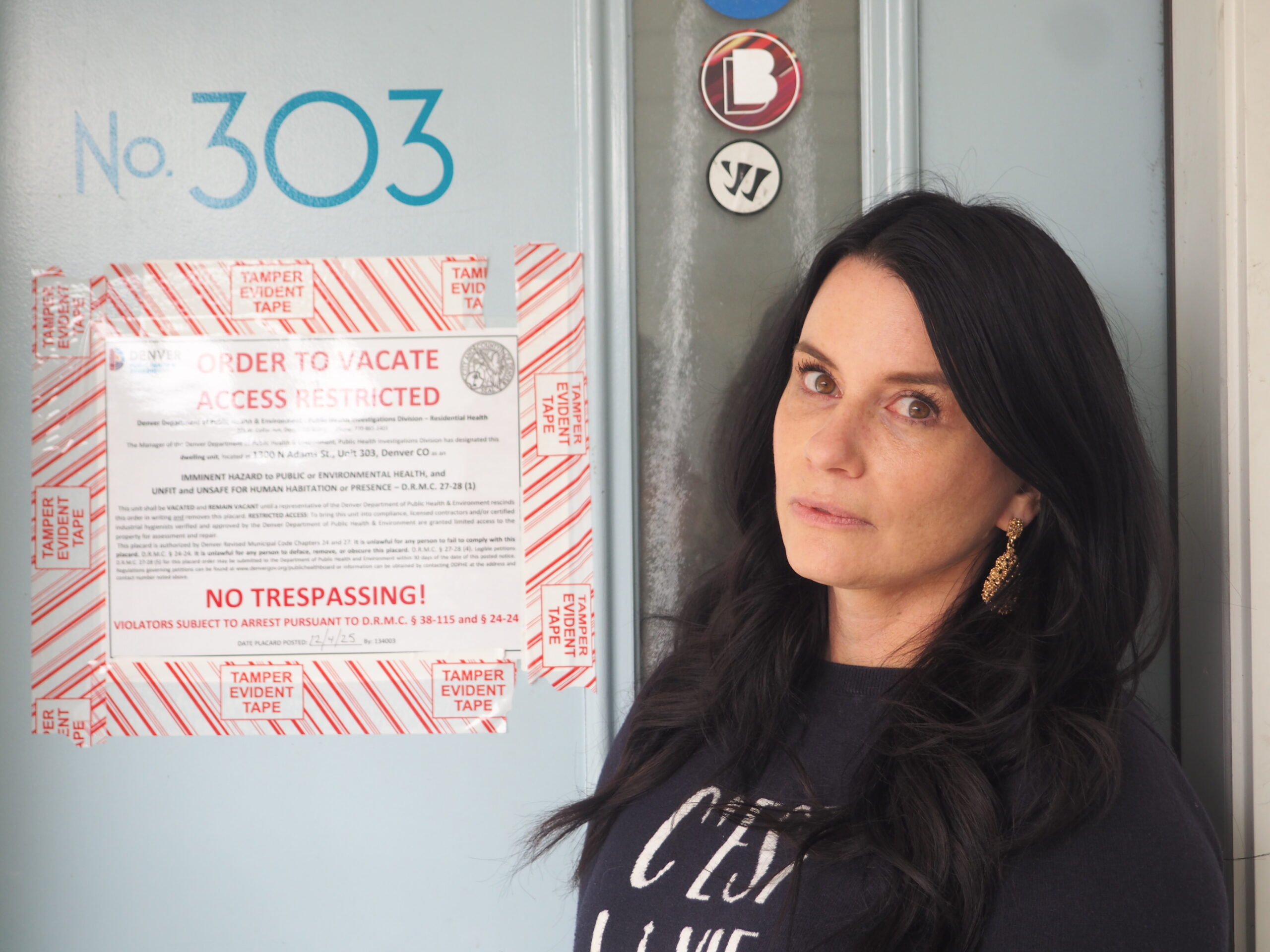
Christina Eisenstein’s family owns the 1300 Adams St. apartment building and has had three of its units test positive for methamphetamine. (Matt Geiger/BusinessDen)
Owen Johnson rented a unit at the White Swan apartment building in May and was out by September.
The 25-year-old chef from Missouri married in July and was slowly moving into the apartment at 1300 Adams St. in Congress Park with his wife when it turned into a nightmare.
“The one (tenant) that was sharing a wall with us, that one was crazy, because all the time we would hear banging on the walls and smell smoke coming from the walls, and we would hear fighting and shouting and slamming,” he said.
“My wife, she never felt safe to walk downstairs by herself,” Johnson said.
Johnson was paying $1,700 a month for a two-bedroom apartment.
His next-door neighbor was using a state housing voucher to pay rent. So too was the person living in the unit below them, along with three others throughout the building. Johnson said countless people milled in and out of the complex, using and dealing drugs and leaving a mess behind them — all tied to the five voucher tenants.
“There were a couple of times where there was so much junk piled up in our courtyard that I just took a pair of gloves and threw it all away,” he said.
The state voucher paid the entire monthly bill — $1,375 to $1,525 — for all but one of the renters, who was paying $200, according to landlord Christina Eisenstein, whose family owns the 18-unit White Swan. It’s one of a handful of buildings they own, including the larger Black Swan complex a block away at 1380 Steele St.
The voucher program places homeless people into housing with landlords willing to take them. Participants are not subjected to a background or criminal history check. The tenants using vouchers at the White Swan listed homeless shelters as their address in their application and have long criminal records, in some cases with violent offenses, according to documents reviewed by BusinessDen.
The vouchers generally do not have a set end date and provide rental assistance to homeless people with “disabling” conditions, according to state documents about the program. That could mean anything from a drug addiction to a mental illness — any “condition that limits an individual’s ability to perform one or more activities of daily living.”
But the tenants abused drugs, destroyed the property and terrified the other tenants, according to Eisenstein.
“They need a place with wraparound services, where they have drug rehab support or mental health support, … because they’re completely out of their mind. I mean, imagine living next to something like that. They’re smoking nonstop, and the fumes are going through, and there’s all this domestic fighting and screaming and broken glass,” Eisenstein said.
When Eisenstein saw the building going downhill she fired her property management firm, Four Star Realty. It had started placing voucher tenants into the building a little over a year ago, she said. Since then, there have been 21 police interactions with the property, which includes reports, arrests and street checks but not calls for service, according to public records.
Eisenstein posted notices in late August that she would be taking back control come September.
“By the next day, I was getting phone calls and emails from tenants basically waving the white flag saying, ‘Please help us,’” she said.
One of those calls came from Tiffany Freccero, who lived in a unit with her husband and infant child. Voucher tenants lived above her.
“They were letting their two dogs poop and pee on the balcony above us, and they started washing the balcony every now and then, and the water, full of all the feces and everything, came down onto our balcony,” she said, adding that her child often played there.

Eisenstein’s mother-in-law purchased the White Swan for $3.8 million in December 2017. It was built in 1960, according to public records. (Courtesy Christina Eisenstein)
Both the Frecceros and Johnsons moved out of the building in September to another that Eisenstein owned. For the past three months, Eisenstein said, she’s been working to expel voucher tenants, too. The battle has been lengthy, draining and a financial black hole.
“I’ve had to become a caseworker. You don’t invest in a property to manage people with mental health issues,” she said.
Four voucher tenants have moved out of the building. Three units have tested positive for methamphetamine consistent with heavy drug use and the other has yet to be examined.
“It’s going to be $300,000 for the remediation, bare minimum. The other cost factor is that we’re at 50% vacancy right now in that building,” Eisenstein said.
‘They didn’t seem to give it credibility’: Landlord points finger at voucher nonprofit
The nonprofit responsible for placing the tenants in the building is the Community Economic Defense Project. It’s one of 44 entities that administer these vouchers across Colorado, according to the state’s housing department.
Founded in 2020 as an informal group of lawyers working pro bono to prevent people from getting evicted in the early days of the pandemic, it’s since become formalized as a key institution in Colorado’s fight against homelessness. It employs 150 people, received $66 million in government grants, according to its 2023 tax filing, and was awarded a three-year, $2.8 million contract with Denver for legal representation in eviction proceedings last month.
Eisenstein said she thought that since the nonprofit was the one that placed voucher tenants with her building, they should be the ones to remove them or correct their behavior. But what followed were months of back-and-forth bickering.
“Eisenstein repeatedly demanded that we do things that only she — the property manager — could do. Worse, she shared security videos and drug tests with the media weeks before she gave them to CEDP, publicly faulting us while withholding the documentation required to escalate the situation to the state,” CEDP co-CEO Zach Neumann said in an email.
“As this was going on, she routinely taunted our staff, at one point texting my personal cell phone to let me know she was ‘going viral,’” he added.
Local TV outlets CBS, Fox and NBC have all run stories about the property with footage provided by Eisenstein.
Eisenstein, meanwhile, said she just wanted to meet face-to-face with Neumann to work out the issues. That never happened.
“They haven’t been easy to work with from the beginning,” she said, pointing to an email from a CEDP case manager who called concerns relayed by Eisenstein and her tenants “hearsay.”
“Here we were, the ship was sinking and they didn’t seem to give it credibility. … They were going to dispute whatever we were showing them,” she said.

Syringes and debris litter the floor of a voucher unit at the White Swan. Einstein blames the tenant. CEDP says she failed to secure the room after the resident moved out. (Matt Geiger/BusinessDen)
CEDP’s charge is narrow and specific. It receives the people with vouchers and is responsible for placing them in an apartment. It then offers light social services, like grocery shopping assistance or transportation to appointments.
“We escalated Christina Eisenstein’s documented complaints within hours of receiving and reviewing them,” Neumann said. “Unfortunately, she complicated this escalation and review process by declining or ignoring dozens of requests, for multiple weeks, to provide our team with the videos and drug tests in her possession, per program requirements. In one case, we saw a video for the first time when it aired on the local news.”
Other landlords in similar positions have evicted the tenants for lease violations, rather than waiting for help from the state and nonprofits. Charlie Hogan, CEO of large property manager Cornerstone Apartments, did this recently for some buildings his company inherited from another management firm.
“Almost every one of these residents is going through the eviction process for nonpayment and behavioral issues,” he said.
“[We had] multiple complaints of unauthorized occupants, drug use, noise complaints — we had [a] guy pour gasoline all over another guy’s door.”
The voucher program does not require participants to be sober or meet work requirements.
“By removing barriers, the state ensures that the most vulnerable individuals are off the streets and connected to a stable environment where they can begin to address health or employment issues,” said Shannon Gray, a spokeswoman for the state’s housing department.
But drug use can still lead to a voucher getting revoked.
“Any illegal use of a drug, or … a pattern of illegal drug use that interferes with the health, safety, or right to peaceful enjoyment of the premises by other residents is a potential reason for termination,” Gray said.
The formerly homeless tenants placed at the White Swan for now are still on their vouchers and have been moved to buildings with more services and landlords that have more experience with voucher tenants. CEDP has sent the meth test results and footage provided by Eisenstein to the state to review and potentially revoke the vouchers.
By next month, all of the voucher tenants will have left the White Swan. All voluntarily agreed to leave, although in two cases Eisenstein paid the tenant $1,500 to do so, she said.
The handoff for one was messy. The tenant moved out Oct. 23, according to CEDP, but associates of the individual stuck around in the apartment.
The two sides disputed whether Eisenstein could remove them, since the lease didn’t expire until Oct. 29. Eisenstein took possession of the unit that day and found a mess. The surfaces were littered with debris and syringes, burnt spoons and dog feces.
Neumann said he could’ve moved voucher tenants to other properties faster if Eisenstein “had engaged with us in good faith.”
But for Owen Johnson, the chef who just wanted a cozy apartment with his bride, all of this has unfolded in the background. The whole ordeal has pushed him out of Denver.
“Downtown and Colfax has just kind of gotten crazy and now that I’ve seen it spread to different parts of [Denver], … I’d rather go back to Missouri or Ohio,” he said.