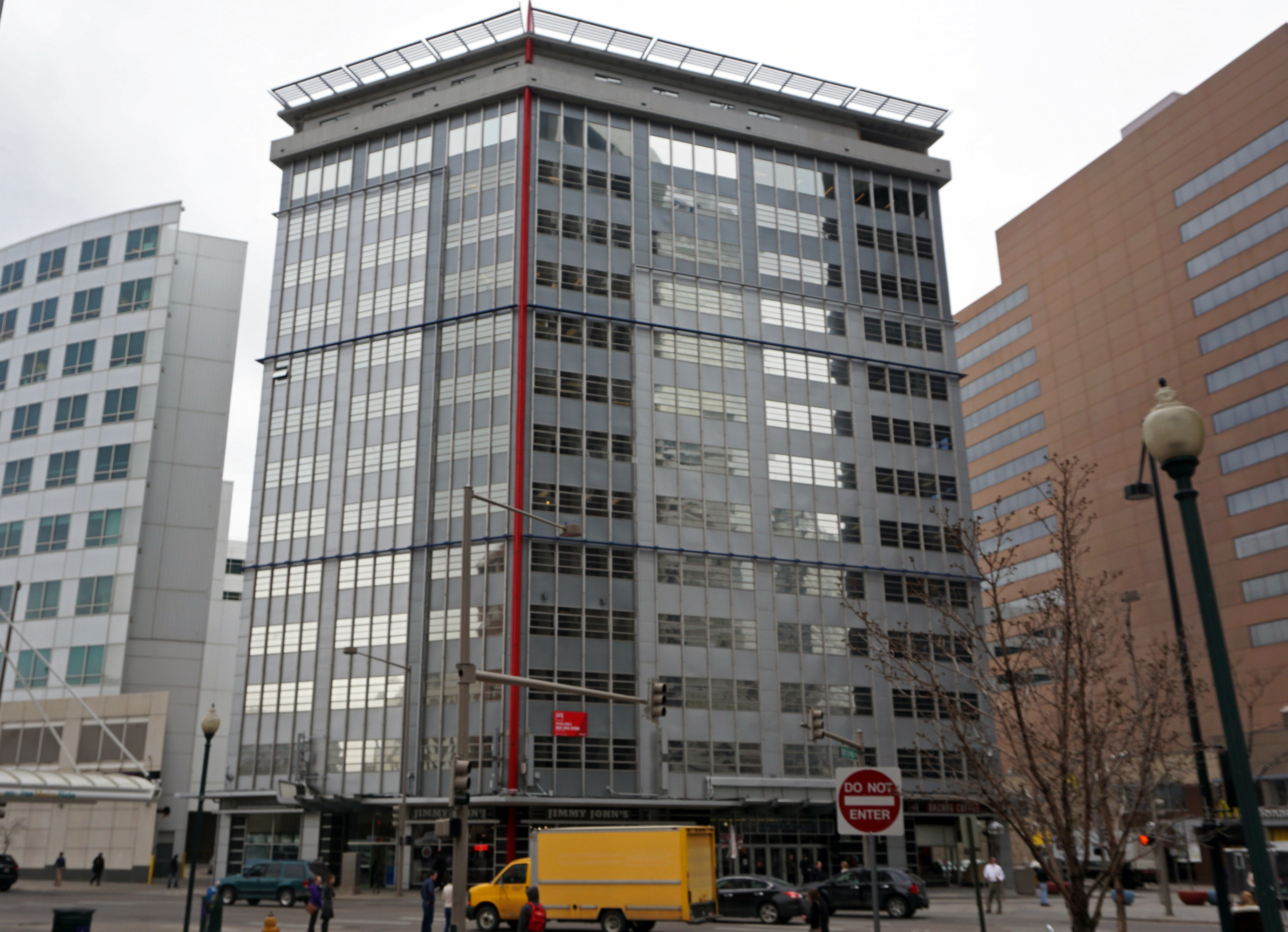
The 14-story building last sold in 2005 and is almost entirely vacant. (BusinessDen file)
Downtown Denver’s Petroleum building, and once a hub for the oil and gas industry, is poised to enter a new age.
On Wednesday, the board of the city’s Downtown Development Authority voted unanimously to lend $14 million to help convert the 200,000-square-foot office building at 110 16th St. into 178 market-rate apartments.
“It’s actually the perfect building for a conversion,” said Tim Borst of Borst & Co., the project’s developer. “It has the right floorplate. It has the right bay depth. It has operable windows. It’s not too large and not too small. It’s absolutely perfect.”
The DDA, a quasi-governmental agency created in 2008 by voters to redevelop Union Station, was expanded last year to the whole of downtown. It is tasked with issuing $570 million in bond money to help revitalize the area.
The 10-year loan at 3% interest for the Petroleum building will cover 20% of the project’s $67.9 million cost, documents show. Construction is expected to begin in the spring.

A rendering of a studio apartment inside the building. Gensler is the architect on the project. (Courtesy of Gensler)
It’s the 12th project awarded by the DDA, which has now approved $166 million of spending. The Denver City Council still needs to sign off on most of it, including the Petroleum building loan.
This is the third office conversion project to be awarded money by the DDA, joining the University building and the Symes building, both also located along the 16th Street Mall.
The 14-story Petroleum building was built in 1957 and was once home to 33 oil firms, The Denver Post reported in 2007. It had a penthouse for oil barons, two floors of club space for their colleagues and was the among the city’s tallest building upon completion.
Borst’s firm, Boulder-based Borst & Co., acquired the building in 2005 for $10.9 million along with DellaCava Holdings, according to public records.
Borst proposed the conversion to apartments in 2021. Back then, the city was in the early stages of forming an adaptive reuse program to address its sudden glut of old, emptying office buildings.
“We had faith that the city was going to figure it out, so we continued to pursue things on our end,” Borst said.
He said the project will restore some of the building’s original architectural details. The inside will pay homage to its midcentury beginnings, with “groovy” furniture. He pointed to the incoming changes at Civic Center Park, a half-block away, as a sign that the whole area is on the rise.
“We think we’re well connected for an adult or a family that wants to live downtown,” Borst said.
But the real selling point is the roof.
“We’re going to build a dog park and dog lounge on the penthouse level. … You’ll be able to grab a beer from the lounge up there and hang out with your dog,” Borst said.
The developer added that he has some ambitious amenity plans, like an on-site electric car-sharing program for residents.
Borst’s firm has primarily been focused on smaller infill and one-off developments.
“This is certainly our biggest project,” he said.
Correction: A previous version of this story referred to the building as being Denver’s tallest when it was built in 1957. It was the sixth tallest.
The 14-story building last sold in 2005 and is almost entirely vacant. (BusinessDen file)
Downtown Denver’s Petroleum building, and once a hub for the oil and gas industry, is poised to enter a new age.
On Wednesday, the board of the city’s Downtown Development Authority voted unanimously to lend $14 million to help convert the 200,000-square-foot office building at 110 16th St. into 178 market-rate apartments.
“It’s actually the perfect building for a conversion,” said Tim Borst of Borst & Co., the project’s developer. “It has the right floorplate. It has the right bay depth. It has operable windows. It’s not too large and not too small. It’s absolutely perfect.”
The DDA, a quasi-governmental agency created in 2008 by voters to redevelop Union Station, was expanded last year to the whole of downtown. It is tasked with issuing $570 million in bond money to help revitalize the area.
The 10-year loan at 3% interest for the Petroleum building will cover 20% of the project’s $67.9 million cost, documents show. Construction is expected to begin in the spring.
A rendering of a studio apartment inside the building. Gensler is the architect on the project. (Courtesy of Gensler)
It’s the 12th project awarded by the DDA, which has now approved $166 million of spending. The Denver City Council still needs to sign off on most of it, including the Petroleum building loan.
This is the third office conversion project to be awarded money by the DDA, joining the University building and the Symes building, both also located along the 16th Street Mall.
The 14-story Petroleum building was built in 1957 and was once home to 33 oil firms, The Denver Post reported in 2007. It had a penthouse for oil barons, two floors of club space for their colleagues and was the among the city’s tallest building upon completion.
Borst’s firm, Boulder-based Borst & Co., acquired the building in 2005 for $10.9 million along with DellaCava Holdings, according to public records.
Borst proposed the conversion to apartments in 2021. Back then, the city was in the early stages of forming an adaptive reuse program to address its sudden glut of old, emptying office buildings.
“We had faith that the city was going to figure it out, so we continued to pursue things on our end,” Borst said.
He said the project will restore some of the building’s original architectural details. The inside will pay homage to its midcentury beginnings, with “groovy” furniture. He pointed to the incoming changes at Civic Center Park, a half-block away, as a sign that the whole area is on the rise.
“We think we’re well connected for an adult or a family that wants to live downtown,” Borst said.
But the real selling point is the roof.
“We’re going to build a dog park and dog lounge on the penthouse level. … You’ll be able to grab a beer from the lounge up there and hang out with your dog,” Borst said.
The developer added that he has some ambitious amenity plans, like an on-site electric car-sharing program for residents.
Borst’s firm has primarily been focused on smaller infill and one-off developments.
“This is certainly our biggest project,” he said.
Correction: A previous version of this story referred to the building as being Denver’s tallest when it was built in 1957. It was the sixth tallest.