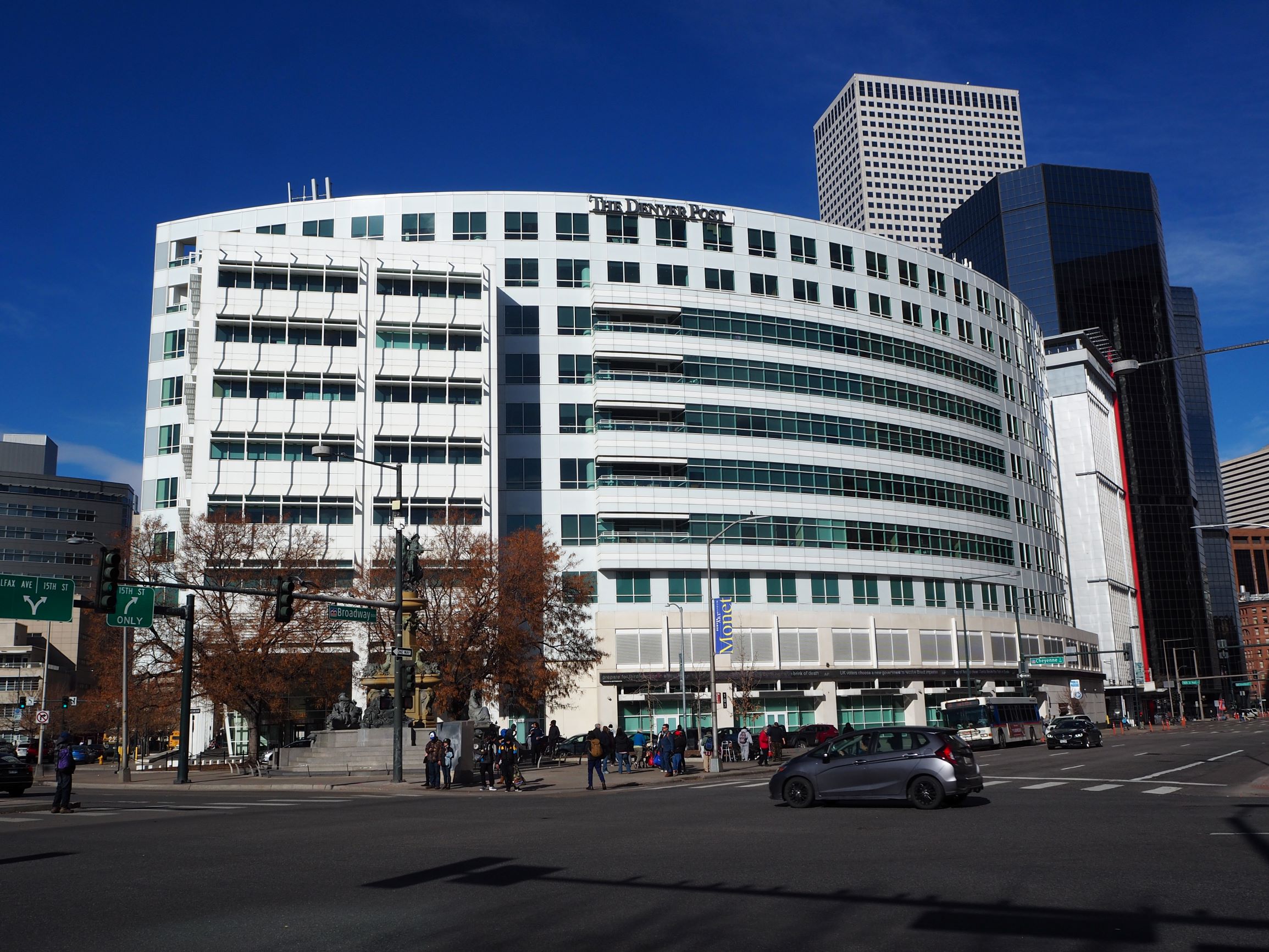
The building at 101 W. Colfax Ave. in Denver in 2019. (BusinessDen file)
The Denver Post didn’t pay rent to the city of Denver for the fourth straight month in November, continuing a tactic that the newspaper hopes will lead to a money-saving settlement.
City officials, meanwhile, took several actions after the situation was publicized last month, records show.
The feud between the city and its most well-known newspaper revolves around 101 W. Colfax Ave., an 11-story office building built in 2006 for the Post and its rival The Rocky Mountain News, the latter of which went out of business in 2009.
Amid revenue declines, the Post, which never owned the building, moved its newsroom to a printing facility in Adams County in 2017. Its other departments moved out by 2020.
The Post, however, remained locked into a lease for the entire building that runs through October 2029. The newspaper attempted to sublease the space and struck several deals — principally with the city, which subleased multiple floors.
Then, in April 2024, Denver bought the building for $88.5 million from an affiliate of New York-based American Properties, planning to eventually expand the city’s court system into the building.
The Post’s lease — which calls for it to pay about $650,000 a month — remained in place after the sale, making Denver both a landlord and subtenant of the newspaper.
On Oct. 20, CBS News Colorado broke the news that the newspaper stopped paying rent for 101 W. Colfax in August and that Denver Mayor Mike Johnston had not told members of the City Council.
The next day, the newspaper published its own story, saying it had “offered to buy out its lease with the city and hopes to reach a mutually beneficial arrangement.”
“We stopped occupying this space while the building was under private ownership long before the city purchased it, so there was never any impression we would be using the space when the city made the decision to purchase the building,” Marshall Anstandig, general counsel for Post parent company MediaNews Group, told the newspaper.
Two days after the CBS report, Johnston directed City Attorney Miko Brown to “institute appropriate proceedings in a court of proper jurisdiction” to recover the unpaid rent and late fees, plus bring any other claims the city might have, according to records provided to BusinessDen.
Then, on Oct. 29, Denver Director of Real Estate Lisa Lumley sent a letter to the building manager at Cushman & Wakefield saying the city was exercising its right to collect rent that other subtenants would normally have paid to the Post.
The Post now owes Denver about $2.7 million for four months of unpaid rent and late fees.
As a subtenant of the Post itself, the city would normally pay rent to the newspaper. It made those payments in August, September and October, despite the Post not paying rent to the city. But Denver did not pay in November, according to Laura Swartz, a spokeswoman for Denver’s finance department.
The building at 101 W. Colfax Ave. in Denver in 2019. (BusinessDen file)
The Denver Post didn’t pay rent to the city of Denver for the fourth straight month in November, continuing a tactic that the newspaper hopes will lead to a money-saving settlement.
City officials, meanwhile, took several actions after the situation was publicized last month, records show.
The feud between the city and its most well-known newspaper revolves around 101 W. Colfax Ave., an 11-story office building built in 2006 for the Post and its rival The Rocky Mountain News, the latter of which went out of business in 2009.
Amid revenue declines, the Post, which never owned the building, moved its newsroom to a printing facility in Adams County in 2017. Its other departments moved out by 2020.
The Post, however, remained locked into a lease for the entire building that runs through October 2029. The newspaper attempted to sublease the space and struck several deals — principally with the city, which subleased multiple floors.
Then, in April 2024, Denver bought the building for $88.5 million from an affiliate of New York-based American Properties, planning to eventually expand the city’s court system into the building.
The Post’s lease — which calls for it to pay about $650,000 a month — remained in place after the sale, making Denver both a landlord and subtenant of the newspaper.
On Oct. 20, CBS News Colorado broke the news that the newspaper stopped paying rent for 101 W. Colfax in August and that Denver Mayor Mike Johnston had not told members of the City Council.
The next day, the newspaper published its own story, saying it had “offered to buy out its lease with the city and hopes to reach a mutually beneficial arrangement.”
“We stopped occupying this space while the building was under private ownership long before the city purchased it, so there was never any impression we would be using the space when the city made the decision to purchase the building,” Marshall Anstandig, general counsel for Post parent company MediaNews Group, told the newspaper.
Two days after the CBS report, Johnston directed City Attorney Miko Brown to “institute appropriate proceedings in a court of proper jurisdiction” to recover the unpaid rent and late fees, plus bring any other claims the city might have, according to records provided to BusinessDen.
Then, on Oct. 29, Denver Director of Real Estate Lisa Lumley sent a letter to the building manager at Cushman & Wakefield saying the city was exercising its right to collect rent that other subtenants would normally have paid to the Post.
The Post now owes Denver about $2.7 million for four months of unpaid rent and late fees.
As a subtenant of the Post itself, the city would normally pay rent to the newspaper. It made those payments in August, September and October, despite the Post not paying rent to the city. But Denver did not pay in November, according to Laura Swartz, a spokeswoman for Denver’s finance department.