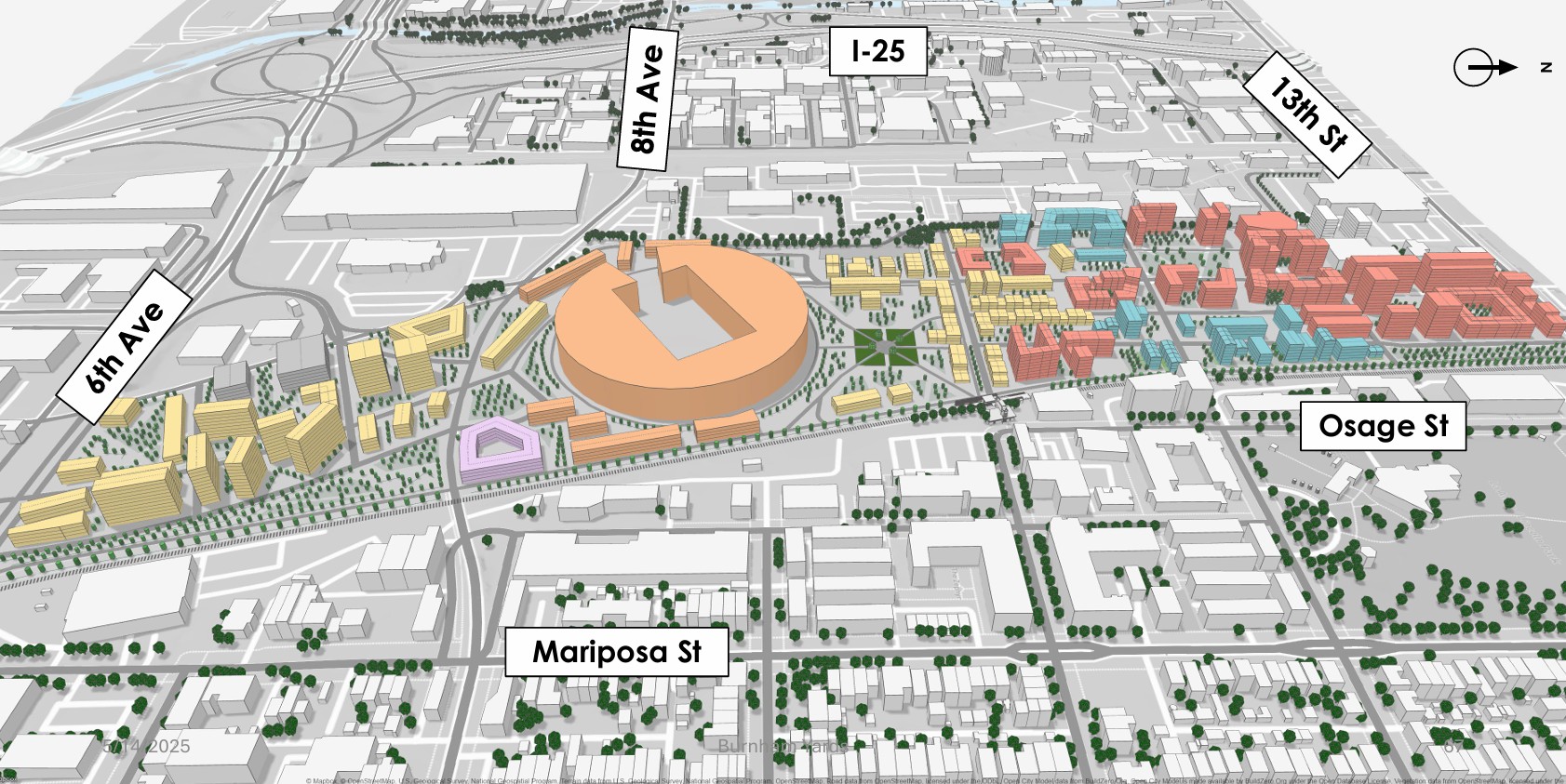
The students’ design plan for Burnham Yard. (Provided)
Samuel Contreras can still remember thinking, “Holy crap, this is actually happening.”
Jack Suva-Urwin, his urban planning school classmate, recalls reaching for a phone.
“I was just texting all of my friends who don’t even go to planning school like, ‘Oh my God, this project that I’m doing is maybe happening in real life!’ It was pretty cool.”
The Denver Broncos’ purchase of $146 million in real estate near Burnham Yard in the Lincoln Park neighborhood, first reported by BusinessDen last month, came as affirmation to six University of Colorado Denver graduate students and their affable teacher.
“Eugene was the one who really helped us think about this area,” Contreras recalled last week, “so my first reaction was to try to figure out how quickly I could message Eugene.”
Eugene Howard, an urban planner with the Colorado Department of Local Affairs and instructor at CU Denver, tasked his spring semester students with imagining possible locations for a new Broncos stadium: near Denver International Airport, at the team’s current Empower Field site, or within Burnham Yard, a 58-acre vacant railyard owned by the state of Colorado.
“I’ve been thinking of this Broncos relocation for at least two years. I’ve been waiting for the right set of students and the right time to introduce it to the classroom, and this was the semester,” Howard said, calling his timing “coincidental but also very much intentional as well.”

Eugene Howard, an instructor at the University of Colorado Denver. (Courtesy CU Denver)
As a result, a half-dozen future planners have already spent months considering what Denverites are only beginning to think about: how a graffitied, polluted old railyard could become the future home of the city’s pro football team, and what that means for those nearby.
“We feel that Burnham Yard is the perfect place for the next Broncos stadium,” said Mackenzie Knox, who was part of the six-student group at CU Denver that reimagined the site during the spring semester. “It really doesn’t make sense for them to go anywhere else.”
The exercises were purely hypothetical; Howard said that he invited the Broncos to participate but received no response.
The Broncos say they have not decided whether to leave Empower Field when their lease expires after the 2030 season or where to place their next stadium if they do. The team says it is considering several options and has neither confirmed nor denied its recent real estate purchases.
A place to go to
Empower Field is something out of an urban planning student’s nightmares: “An empty shell surrounded by parking lots,” as Contreras puts it. “And nobody goes there.”
“My initial response to the assignment,” Suva-Urwin said, “was, ‘I don’t really like stadiums that much to begin with and is the Broncos stadium even that old?’ Apparently it is.”
But apprehension gave way to excitement as the group of six made their way to Lincoln Park and spoke with residents about what they would like to see at a stadium site.
“It’s preserving the industrial area around the stadium,” Suva-Urwin said of his takeaway. “Some people see it as a negative, but I think the neighborhood itself sees it as a positive. And I think there is a way to preserve those businesses — an elegant way to do that.”
The concept they created is far more than a stadium. Thirteenth Street would become a bridge over the RTD line, Pecos Street and Quivas Street. The RTD stop at 10th and Osage would multiply in size. Park-and-ride buses would move commuters to and from the stadium. A linear park would line the southeast of Burnham Yard and be filled with native plants.
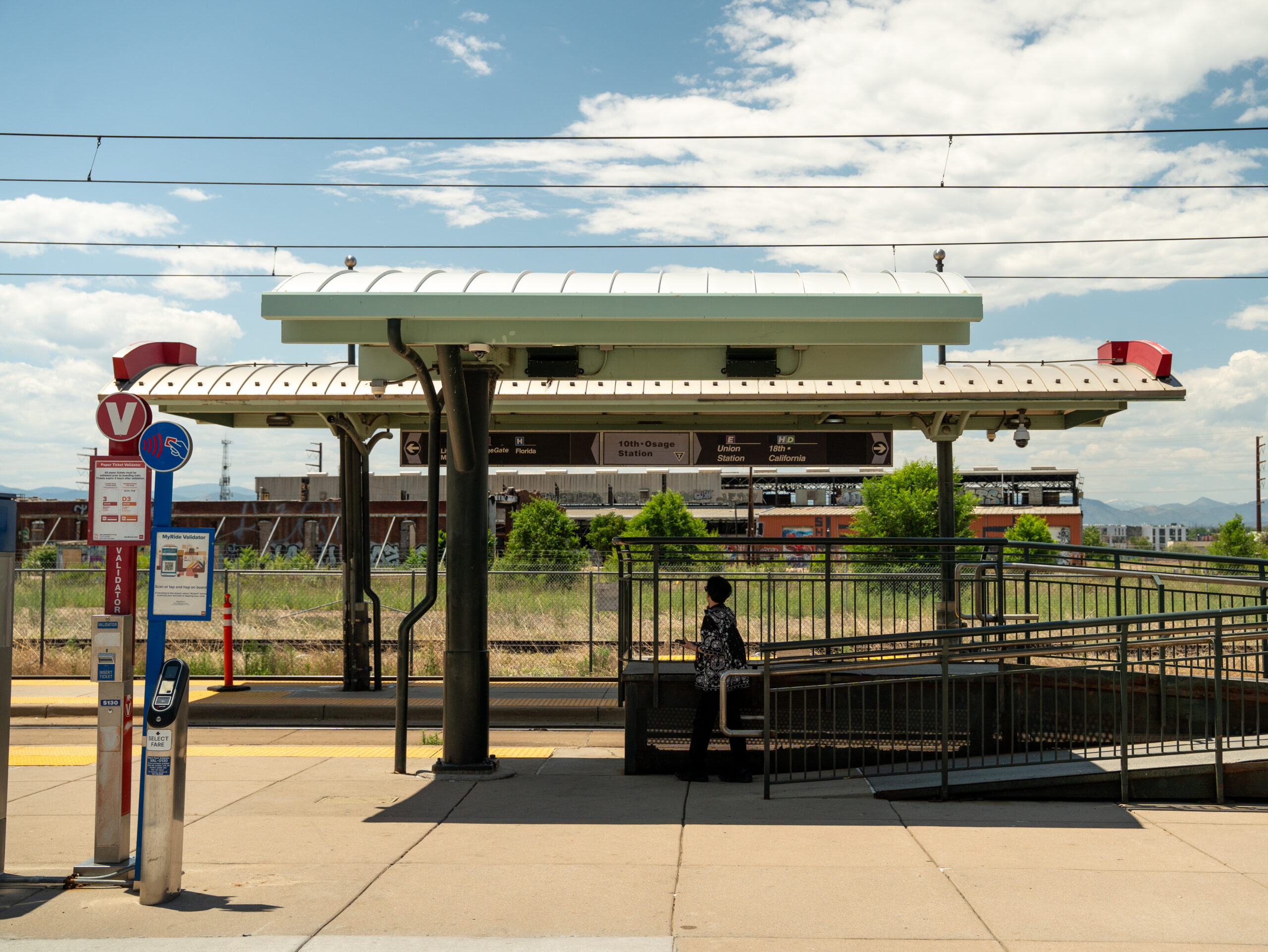
The RTD stop at 10th and Osage in Lincoln Park on Thursday, June 26, 2025. (BusinessDen file)
A visitor center would teach the history of the railyard and Lincoln Park, one of the city’s oldest neighborhoods. Apartment projects and office buildings and greenspaces would lead inward to a promenade of storefronts and, finally, at the center of it all, the new stadium.
“We want this place to not just feel alive during game day,” Contreras said during a presentation before Howard of the group’s concept. “On all the other days — the 358 days that games are not happening — we want this to be a place that people will actually go to.”
The Mile High neighborhood
Assuming then that the Broncos build a new stadium, what happens to Empower Field?
“Realistically, I think it’s hard to say that we recommend leaving the stadium as is and using it for events,” said Jordan Freeburn, another urban planning student from Howard’s spring semester class, “because there will be other stadiums that will take those events.”
Freeburn and a group of five classmates were challenged to design a new stadium site at Empower Field. But after one day, they flipped the script on their instructor. What if, instead, Empower Field went away? What would replace it? The answer, they say, is a neighborhood.
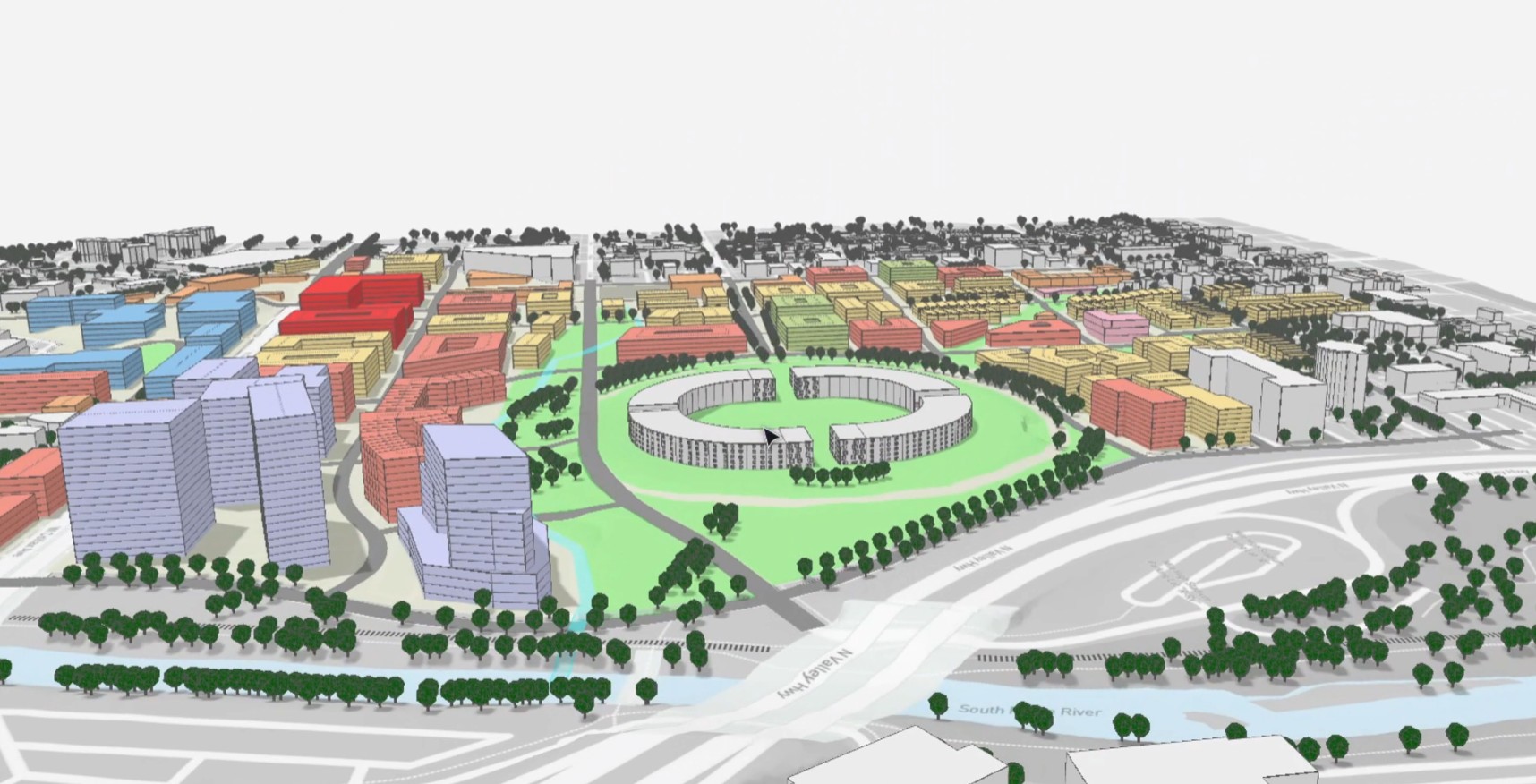
The students’ plan for development on the current site of Empower Field at Mile High. (Provided)
A standard street grid would fit over what are now parking lots and the cloverleaf intersection of Colfax and Federal would be replaced by a more typical four-way stop. An oval apartment project with a courtyard in the center would fit on the current stadium site. Around it would be housing and office developments, shops and restaurants galore.
“Whether the stadium is replaced or not, our biggest aspect is removing all of this parking and replacing it with something the surrounding community can use,” said Molly Heneghan.
What happens to Empower Field and Burnham Yard remains to be seen. But both groups of graduate students in Howard’s class say their projects recently took on outsized importance. “A shift in the atmosphere,” as student Tristan Palmero put it.
“Suddenly it was like, ‘OK, we better know what we’re talking about,’” he recalls thinking.
Read more: Broncos buying around possible Denver stadium site
Read more: Broncos, Denver Water talking about agency’s land near possible stadium site
Read more: Broncos must build income-restricted housing after $7M deal by Burnham Yard
Read more: Amid Broncos talks, Denver Water tells neighbors it ‘intends’ to buy their property
The students’ design plan for Burnham Yard. (Provided)
Samuel Contreras can still remember thinking, “Holy crap, this is actually happening.”
Jack Suva-Urwin, his urban planning school classmate, recalls reaching for a phone.
“I was just texting all of my friends who don’t even go to planning school like, ‘Oh my God, this project that I’m doing is maybe happening in real life!’ It was pretty cool.”
The Denver Broncos’ purchase of $146 million in real estate near Burnham Yard in the Lincoln Park neighborhood, first reported by BusinessDen last month, came as affirmation to six University of Colorado Denver graduate students and their affable teacher.
“Eugene was the one who really helped us think about this area,” Contreras recalled last week, “so my first reaction was to try to figure out how quickly I could message Eugene.”
Eugene Howard, an urban planner with the Colorado Department of Local Affairs and instructor at CU Denver, tasked his spring semester students with imagining possible locations for a new Broncos stadium: near Denver International Airport, at the team’s current Empower Field site, or within Burnham Yard, a 58-acre vacant railyard owned by the state of Colorado.
“I’ve been thinking of this Broncos relocation for at least two years. I’ve been waiting for the right set of students and the right time to introduce it to the classroom, and this was the semester,” Howard said, calling his timing “coincidental but also very much intentional as well.”
Eugene Howard, an instructor at the University of Colorado Denver. (Courtesy CU Denver)
As a result, a half-dozen future planners have already spent months considering what Denverites are only beginning to think about: how a graffitied, polluted old railyard could become the future home of the city’s pro football team, and what that means for those nearby.
“We feel that Burnham Yard is the perfect place for the next Broncos stadium,” said Mackenzie Knox, who was part of the six-student group at CU Denver that reimagined the site during the spring semester. “It really doesn’t make sense for them to go anywhere else.”
The exercises were purely hypothetical; Howard said that he invited the Broncos to participate but received no response.
The Broncos say they have not decided whether to leave Empower Field when their lease expires after the 2030 season or where to place their next stadium if they do. The team says it is considering several options and has neither confirmed nor denied its recent real estate purchases.
A place to go to
Empower Field is something out of an urban planning student’s nightmares: “An empty shell surrounded by parking lots,” as Contreras puts it. “And nobody goes there.”
“My initial response to the assignment,” Suva-Urwin said, “was, ‘I don’t really like stadiums that much to begin with and is the Broncos stadium even that old?’ Apparently it is.”
But apprehension gave way to excitement as the group of six made their way to Lincoln Park and spoke with residents about what they would like to see at a stadium site.
“It’s preserving the industrial area around the stadium,” Suva-Urwin said of his takeaway. “Some people see it as a negative, but I think the neighborhood itself sees it as a positive. And I think there is a way to preserve those businesses — an elegant way to do that.”
The concept they created is far more than a stadium. Thirteenth Street would become a bridge over the RTD line, Pecos Street and Quivas Street. The RTD stop at 10th and Osage would multiply in size. Park-and-ride buses would move commuters to and from the stadium. A linear park would line the southeast of Burnham Yard and be filled with native plants.
The RTD stop at 10th and Osage in Lincoln Park on Thursday, June 26, 2025. (BusinessDen file)
A visitor center would teach the history of the railyard and Lincoln Park, one of the city’s oldest neighborhoods. Apartment projects and office buildings and greenspaces would lead inward to a promenade of storefronts and, finally, at the center of it all, the new stadium.
“We want this place to not just feel alive during game day,” Contreras said during a presentation before Howard of the group’s concept. “On all the other days — the 358 days that games are not happening — we want this to be a place that people will actually go to.”
The Mile High neighborhood
Assuming then that the Broncos build a new stadium, what happens to Empower Field?
“Realistically, I think it’s hard to say that we recommend leaving the stadium as is and using it for events,” said Jordan Freeburn, another urban planning student from Howard’s spring semester class, “because there will be other stadiums that will take those events.”
Freeburn and a group of five classmates were challenged to design a new stadium site at Empower Field. But after one day, they flipped the script on their instructor. What if, instead, Empower Field went away? What would replace it? The answer, they say, is a neighborhood.
The students’ plan for development on the current site of Empower Field at Mile High. (Provided)
A standard street grid would fit over what are now parking lots and the cloverleaf intersection of Colfax and Federal would be replaced by a more typical four-way stop. An oval apartment project with a courtyard in the center would fit on the current stadium site. Around it would be housing and office developments, shops and restaurants galore.
“Whether the stadium is replaced or not, our biggest aspect is removing all of this parking and replacing it with something the surrounding community can use,” said Molly Heneghan.
What happens to Empower Field and Burnham Yard remains to be seen. But both groups of graduate students in Howard’s class say their projects recently took on outsized importance. “A shift in the atmosphere,” as student Tristan Palmero put it.
“Suddenly it was like, ‘OK, we better know what we’re talking about,’” he recalls thinking.
Read more: Broncos buying around possible Denver stadium site
Read more: Broncos, Denver Water talking about agency’s land near possible stadium site
Read more: Broncos must build income-restricted housing after $7M deal by Burnham Yard
Read more: Amid Broncos talks, Denver Water tells neighbors it ‘intends’ to buy their property